
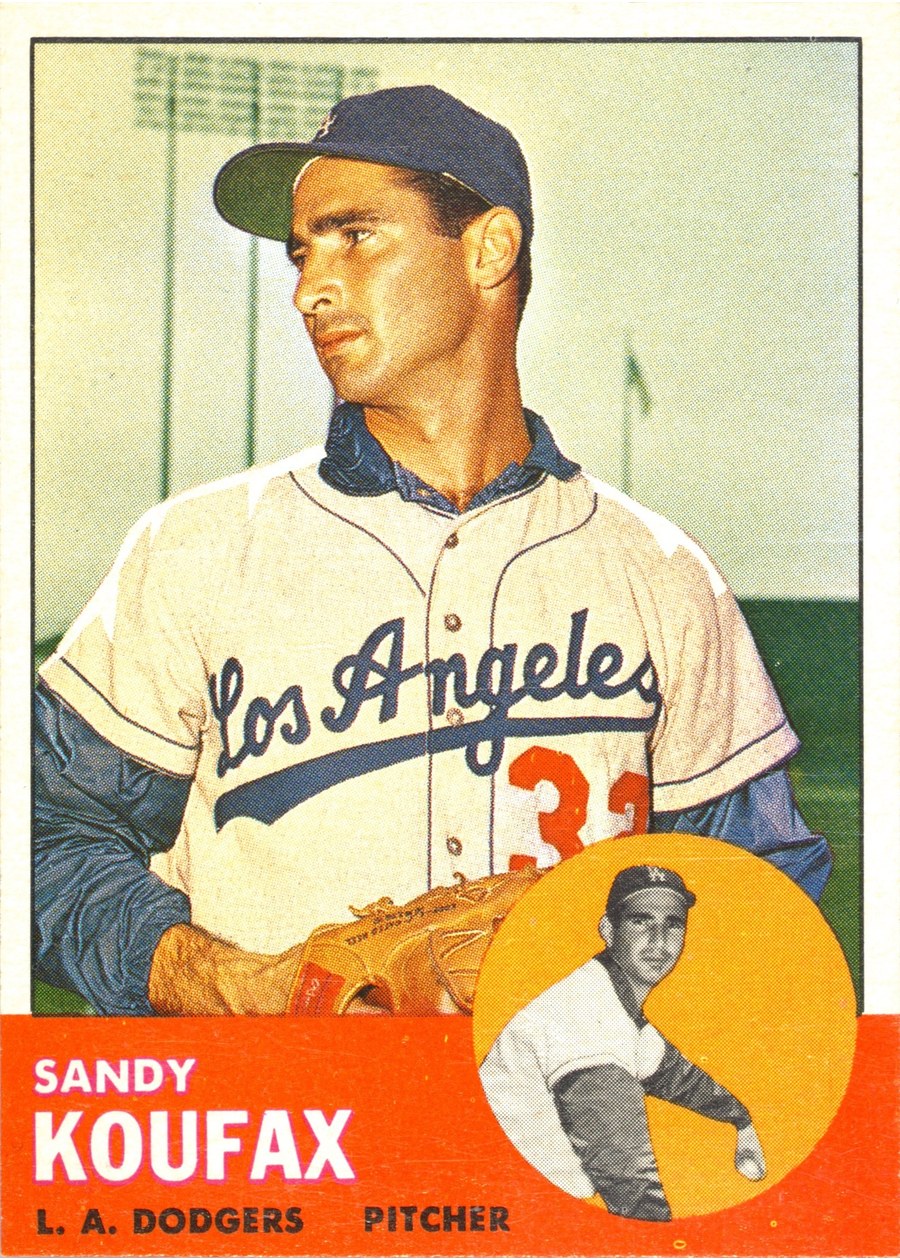
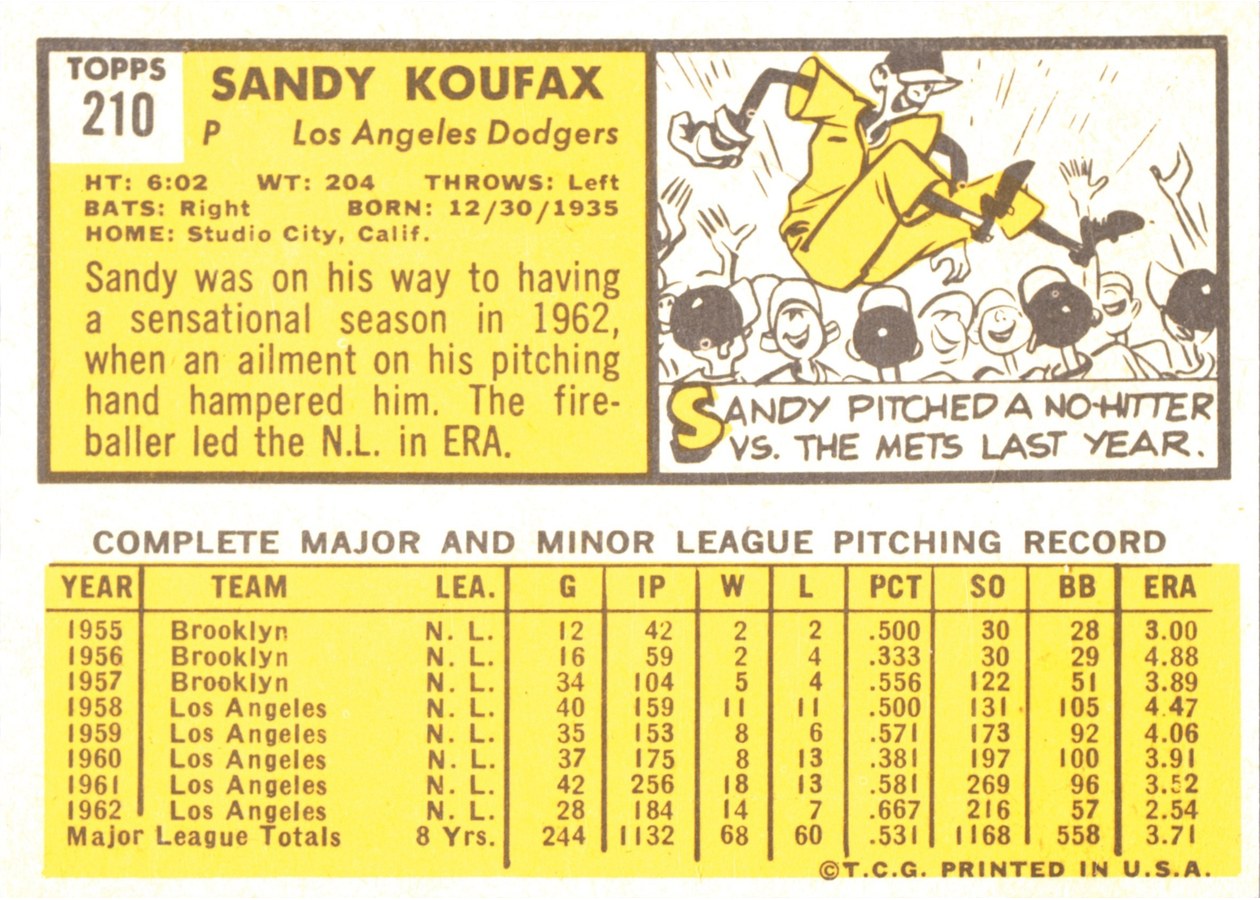
1963 Topps #210 Sandy Koufax
About Sandy Koufax
Four 1963 cards carry him. Numbers 5 and 9 are the National League ERA and strikeout boards from the first series: Koufax tops the ERA list at 2.54 ahead of Bob Shaw, Bob Purkey, Don Drysdale and Bob Gibson, and stands second in strikeouts with 216, behind Drysdale. Both come out of a 14-7 season that a circulatory problem in his pitching hand interrupted from July until September 21, costing him 58 games and roughly 13 starts. He had already thrown the first of his four no-hitters, 5-0 over the expansion Mets on June 30, 1962. Number 210, from series three, is his own card; number 412, the Dodgers' Big Three, puts him with Johnny Podres and Drysdale in series five.
Sanford Koufax, born Sanford Braun in Brooklyn, signed with his hometown Dodgers in December 1954 as a bonus-rule player and never spent a day in the minor leagues; the missing apprenticeship left him wild for six seasons. The turn came in 1961, when a tightened delivery and a catcher's advice to stop overthrowing made him a winning pitcher. He led the National League in earned run average five straight years, 1962 through 1966, and was an All-Star in each of his last six seasons. He threw four no-hitters, one of them a perfect game against the Chicago Cubs on September 9, 1965, and won the Cy Young Award three times, in 1963, 1965 and 1966, each time unanimously and as the sport's only winner before the award split by league. He added the 1963 National League Most Valuable Player award and the pitching Triple Crown in all three Cy Young years, was World Series MVP in 1963 and 1965, and led the Dodgers to titles both years; his refusal to pitch Game 1 of the 1965 Series on Yom Kippur made him a lasting figure in American Jewish life. Arthritis in his elbow forced him out after 1966 at 30, and he entered the National Baseball Hall of Fame in 1972, at 36 the youngest player ever inducted.
Sources: Wikipedia · SABR BioProject · Baseball-Reference · National Baseball Hall of Fame
Graded population (PSA & SGC)
| Grader | Total | 10 | 9 | 8 | 7 | 6 | 5 | 1-4 | Auth |
|---|---|---|---|---|---|---|---|---|---|
| PSA | 3,765 | 0 | 20 | 277 | 628 | 852 | 671 | 1,306 | 11 |
| SGC | 1,542 | 0 | 4 | 31 | 120 | 242 | 381 | 701 | 63 |
Graded population — a scarcity guide, not a price. Snapshot 2026-09-24. Half-grades fold down (8.5→8), and PSA's qualified grades are counted separately from the straight-grade rows shown here.
Find this card
Search T206 Cards Live auctions Buy It Now on eBay Sold prices
As an eBay Partner Network affiliate, T206Cards.com may earn from qualifying purchases.
Related cards
More Sandy Koufax in this set: #5 League Leaders, #9 League Leaders, #412 Combo
Team card: #337 Los Angeles Dodgers
More Los Angeles Dodgers cards:
- #1 1962 National League Batting Leaders
- #5 1962 National League E.R.A. Leaders
- #7 1962 National League Pitching Leaders
- #9 1962 National League Strikeout Leaders
- #11 Lee Walls
- #53 Joe Moeller
- #68 Friendly Foes
- #80 Jim Gilliam
- #105 Ron Fairly
- #123 Frank Howard
- #150 Johnny Podres
- #154 Walt Alston
- #180 Bill Skowron
- #196 Doug Camilli
Frequently asked questions
What is the 1963 Topps #210 card?
It is card #210 of the 576-card 1963 Topps Baseball set, picturing Sandy Koufax of the Los Angeles Dodgers.
What are the key cards in the 1963 Topps set?
The #537 Rookie Stars card, Pete Rose's rookie card, leads the set. Beside it at the top sit #200 Mickey Mantle and #540 Bob Clemente, then #300 Willie Mays, #390 Hank Aaron, #210 Sandy Koufax, #340 Yogi Berra, #472 Lou Brock, #500 Harmon Killebrew (one of the four short prints) and the Rookie Stars cards with Willie Stargell (#553) and Tony Oliva (#228). The scarce sixth and seventh series (#447-576) hold the short prints and the hardest cards to find.
How many cards are in the 1963 Topps Baseball set?
576 cards, tracked as 583 collectible states. The numbers run from 1 to 576 with no gaps and no number used twice, and seven cards carry a catalogued print variation - three checklists, the two Rookie Stars cards also printed with a "1962" heading, and the #341 Jack Baldschun and #454 Art Fowler print states - that the master set counts separately.
Sources: Trading Card Database, PSA CardFacts, Cardboard Connection, BaseballCardPedia, The Topps Archives, Baseball-Reference, the SABR BioProject and the National Baseball Hall of Fame, PSA & SGC population reports. Card data compiled and maintained by T206Cards.com. Page last updated 2026-10-03.