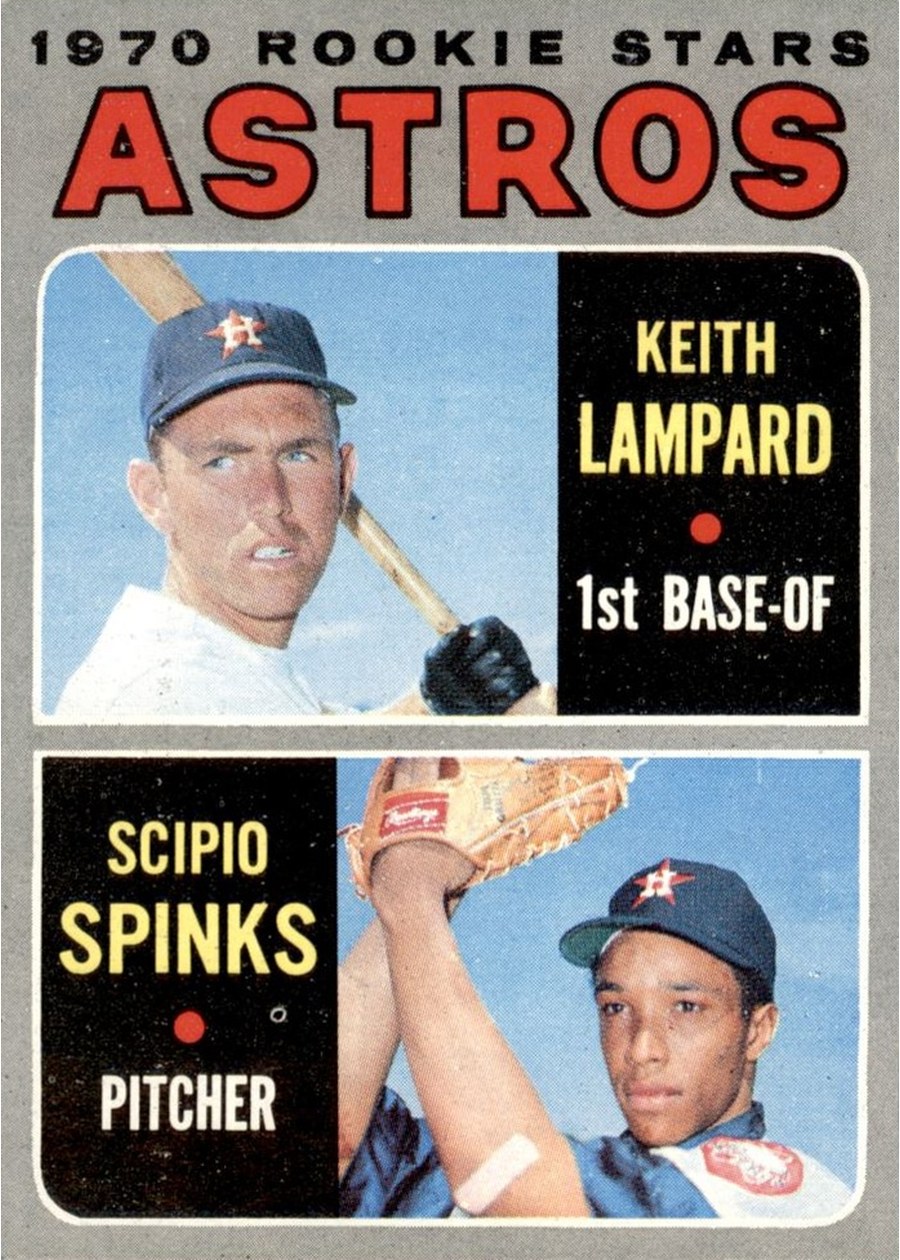
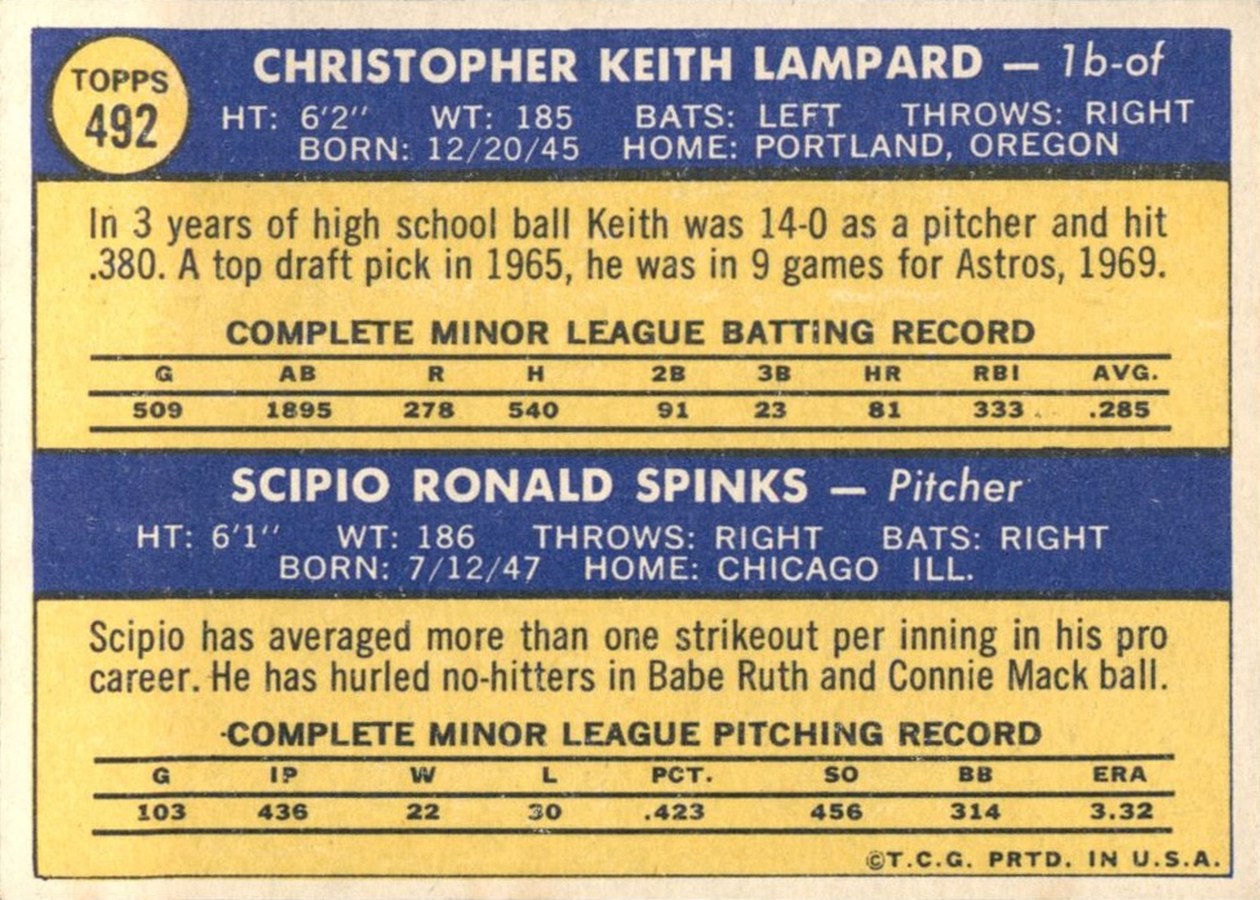
1970 Topps #492 Astros Rookie Stars - Keith Lampard / Scipio Spinks
On this card: Keith Lampard, Scipio Spinks
About this card
This is one of the forty Rookie Stars cards, each showing two or three rookies from one club; #654 (National League) and #702 (American League) each mix three clubs. A Rookie Stars card is a rookie card for the players on it who had no earlier Topps flagship card - on #36, #74, #109, #154, #267, #317, #429, #573, #669 and #683 one of them had already appeared on one, and the rookie-card answer on each card names the players it counts for.
The story on this card
Lampard was in Houston nearly all of 1970, apart from a brief June option to Oklahoma City, and pinch-hitting was the job: 43 pinch-hit appearances against six starts. The outfield was crowded once the Astros promoted 19-year-old Cesar Cedeno in June and traded Tommy Davis. Manager Harry Walker had him lean on his front foot, the slashing style Lampard said Walker favored in the Astrodome. Card #492 is a two-man Astros Rookie Stars card with Scipio Spinks, the rookie card for both. Keith Lampard, an English-born outfielder raised in Portland, Oregon, played 62 games for the Houston Astros in 1969 and 1970. His only major-league home run, a two-run pinch-hit shot off Wayne Granger on September 19, 1969, ended a game at the Astrodome.
Spinks debuted on September 16, 1969, at San Diego Stadium, striking out the last four batters he faced in two innings, and later that month lifted the headdress of the Braves' mascot, Chief Noc-A-Homa. In 1970 he pitched five games for Houston, going 0-1 with a 9.88 ERA, and went 9-12 at Oklahoma City. He shares #492, a Rookie Stars card from the fifth series, with Keith Lampard; both are printed with the Astros and it is the rookie card for both. Chicago-born right-hander with the Astros and Cardinals from 1969 to 1973, known for a Northern League record 20-strikeout game in 1966 and a fastball that put him among the National League strikeout leaders in 1972.
Sources: Wikipedia (Keith Lampard) · Wikipedia (Scipio Spinks) · SABR BioProject (Keith Lampard) · SABR BioProject (Scipio Spinks) · BaseballCardPedia
Graded population (PSA & SGC)
| Grader | Total | 10 | 9 | 8 | 7 | 6 | 5 | 1-4 | Auth |
|---|---|---|---|---|---|---|---|---|---|
| PSA | 271 | 3 | 49 | 165 | 40 | 9 | 3 | 0 | 2 |
| SGC | 8 | 0 | 1 | 5 | 2 | 0 | 0 | 0 | 0 |
Graded population — a scarcity guide, not a price. Data as of 2026-10-19. Half grades fold down for both graders (8.5→8); PSA qualified slabs (OC, ST, PD, MC and the like) are not counted.
Find this card
Search T206 Cards Shop 1970 Topps cards Live auctions Buy It Now on eBay Sold prices
As an eBay Partner Network affiliate, T206Cards.com may earn from qualifying purchases.
Related cards
Team card: #448 Houston Astros
More Houston Astros cards:
- #15 Larry Dierker
- #32 Harry Walker
- #60 Jim Wynn
- #113 Jim Ray
- #126 Marty Martinez
- #155 Denis Menke
- #178 Denny Lemaster
- #208 Fred Gladding
- #227 Astros 1970 Rookie Stars
- #248 Jesus Alou
- #272 Hector Torres
- #316 Skip Guinn
- #339 Johnny Edwards
- #355 Doug Rader
Frequently asked questions
What is the 1970 Topps #492 card?
It is card #492 of the 720-card 1970 Topps Baseball set, picturing Keith Lampard and Scipio Spinks. This is one of the forty Rookie Stars cards, each showing two or three rookies from one club; #654 (National League) and #702 (American League) each mix three clubs. A Rookie Stars card is a rookie card for the players on it who had no earlier Topps flagship card - on #36, #74, #109, #154, #267, #317, #429, #573, #669 and #683 one of them had already appeared on one, and the rookie-card answer on each card names the players it counts for.
Is 1970 Topps #492 a rookie card?
Yes - #492 is a rookie card for every player pictured on it: Keith Lampard and Scipio Spinks.
How many cards are in the 1970 Topps Baseball set?
720 cards, tracked as 726 collectible states. Numbers run from 1 to 720 with none skipped, issued in seven series - #1-132, #133-263, #264-372, #373-459, #460-546, #547-633 and the high numbers, #634-720; 6 cards, all of them checklists, carry catalogued print variations that the master set counts separately.
Sources: Trading Card Database, PSA CardFacts, BaseballCardPedia, Cardboard Connection, Baseball Almanac, Baseball-Reference, the SABR BioProject and the National Baseball Hall of Fame, PSA & SGC population reports. Card data compiled and maintained by T206Cards.com. Page last updated 2026-10-25.