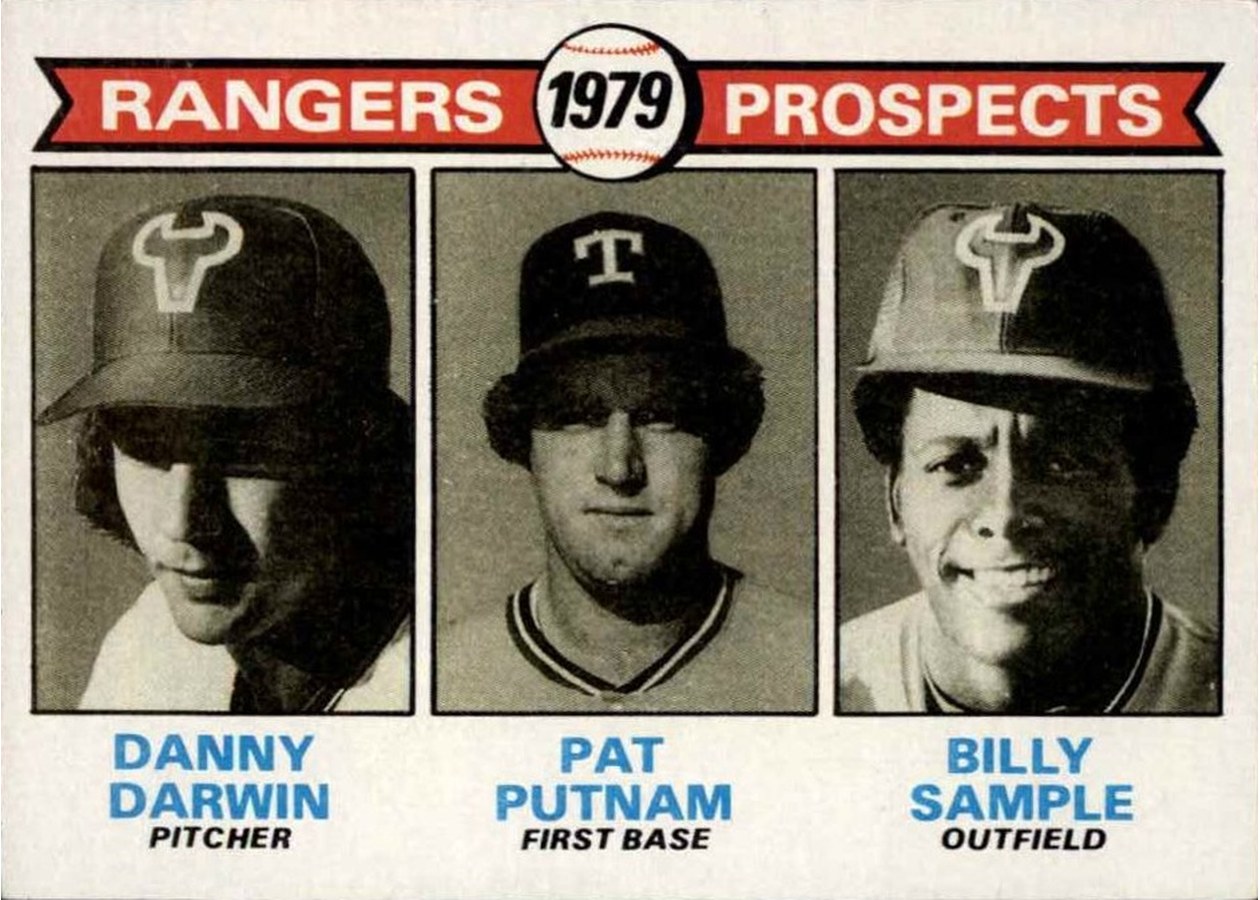
1979 Topps #713 Rangers Prospects - Danny Darwin / Pat Putnam / Billy Sample
On this card: Danny Darwin, Pat Putnam, Billy Sample
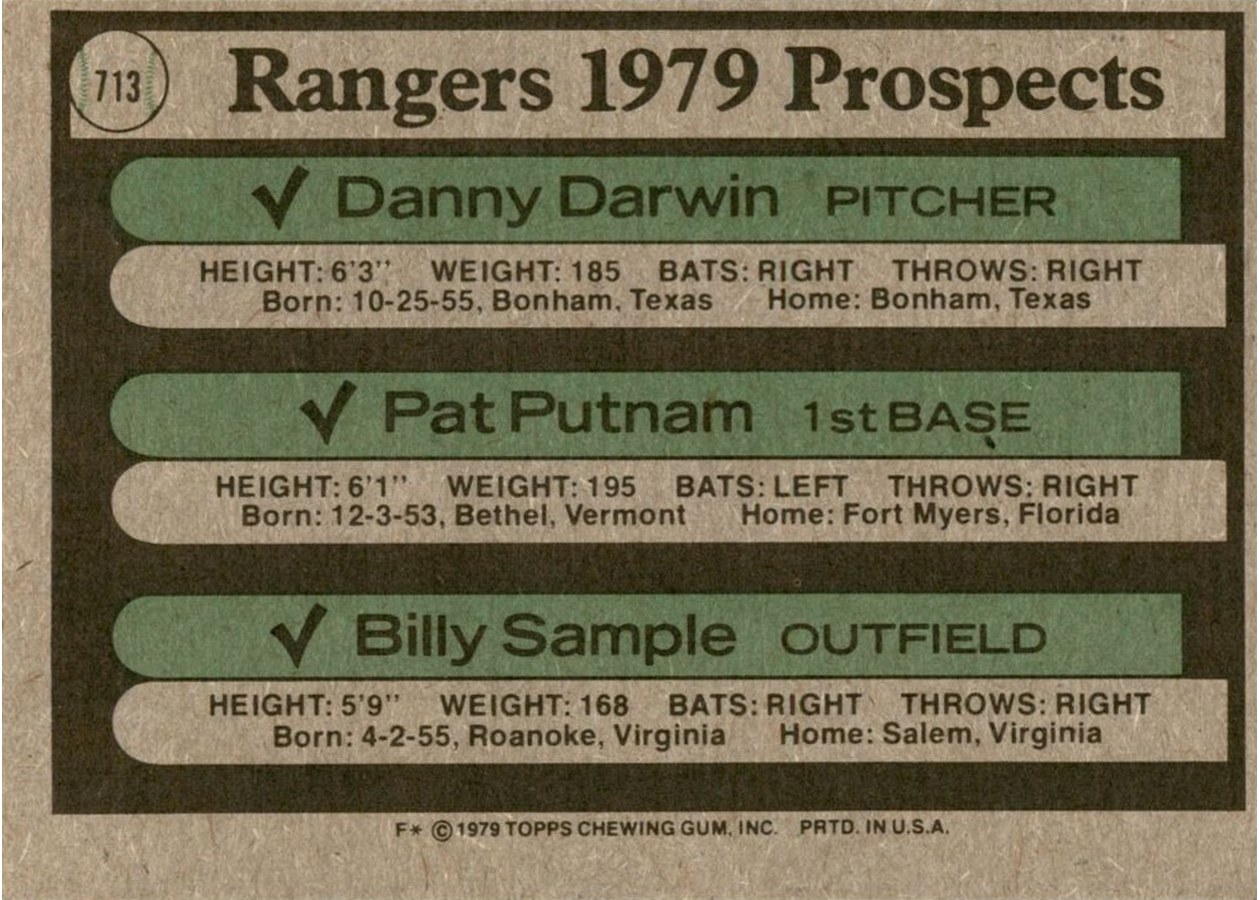
About this card
Cards #701-726 are the 26 three-player Prospects cards, one per club - AL clubs first, each league in alphabetical order by city - with black-and-white player photos on the front. A Prospects card is a rookie card for the players on it who had no earlier Topps flagship card. On #703, #705, #712, #718 and #723, one or two of the players never reached the major leagues.
The story on this card
Darwin won his first major-league start on September 24, 1978, pitching 6 innings against Seattle. His rookie card, 1979 Topps #713, grouped him with Pat Putnam and Billy Sample as Rangers Prospects. In 1979, he went 4-4 with a 4.04 ERA in 78 innings for Texas. Rangers broadcaster Mark Holtz nicknamed right-hander Danny Darwin "The Bonham Bullet" for his hometown and fastball. Darwin's nickname appeared on T-shirts during his years with Texas.
Putnam made the Rangers out of spring training in 1979 after Mike Hargrove was traded to San Diego. He took over at first base after starter Mike Jorgensen was hit in the head by an Andy Hassler pitch on May 28, and he played 139 games with 64 RBI. His 1979 card is #713, a Rangers Prospects card shared with Danny Darwin and Billy Sample. Pat Putnam, a left-handed first baseman, was The Sporting News Minor League Player of the Year in 1976 and its American League Rookie of the Year in 1979 with Texas, then led Seattle with 19 home runs in 1983 before playing in Japan.
Sample played 128 games for Texas in 1979 and was named to Topps' All-Rookie team. He batted .292 with 5 home runs and 35 RBI. His rookie card appeared in the Rangers Prospects group on 1979 Topps #713, with Danny Darwin and Pat Putnam. Texas outfielder Billy Sample singled on the first pitch he saw in the majors in September 1978. He collected 7 hits in 15 at-bats during that initial 8-game call-up.
Sources: Wikipedia (Danny Darwin) · Wikipedia (Pat Putnam) · Wikipedia (Billy Sample) · SABR BioProject (Danny Darwin) · SABR BioProject (Pat Putnam) · BaseballCardPedia · Trading Card Database
Graded population (PSA & SGC)
| Grader | Total | 10 | 9 | 8 | 7 | 6 | 5 | 1-4 | Auth |
|---|---|---|---|---|---|---|---|---|---|
| PSA | 171 | 25 | 107 | 26 | 9 | 1 | 2 | 1 | 0 |
| SGC | 4 | 1 | 1 | 2 | 0 | 0 | 0 | 0 | 0 |
Graded population — a scarcity guide, not a price. Data as of 2026-10-19. Half grades fold down for both graders (8.5→8); PSA qualified slabs (OC, ST, PD, MC and the like) are not counted.
Find this card
Search T206 Cards Shop 1979 Topps cards Live auctions Buy It Now on eBay Sold prices
As an eBay Partner Network affiliate, T206Cards.com may earn from qualifying purchases.
Related cards
Team card: #499 Texas Rangers / Pat Corrales
More Texas Rangers cards:
- #22 Mike Jorgensen
- #44 Kurt Bevacqua
- #67 Jim Mason
- #94 Len Barker
- #120 Jim Sundberg
- #144 Sandy Alomar
- #173 John Lowenstein
- #198 Johnny Grubb
- #209 Reggie Cleveland
- #234 Toby Harrah
- #260 Richie Zisk
- #285 Bobby Bonds
- #315 Jon Matlack
- #336 Bobby Thompson
Frequently asked questions
What is the 1979 Topps #713 card?
It is card #713 of the 726-card 1979 Topps Baseball set, picturing Danny Darwin, Pat Putnam and Billy Sample. Cards #701-726 are the 26 three-player Prospects cards, one per club - AL clubs first, each league in alphabetical order by city - with black-and-white player photos on the front. A Prospects card is a rookie card for the players on it who had no earlier Topps flagship card. On #703, #705, #712, #718 and #723, one or two of the players never reached the major leagues.
Is 1979 Topps #713 a rookie card?
Yes - #713 is the rookie card of Danny Darwin and Billy Sample. Pat Putnam had already appeared on an earlier Topps card, so it is not his rookie card.
How many cards are in the 1979 Topps Baseball set?
726 cards, numbered 1 through 726 with none skipped and issued as a single series, tracked as 727 collectible states: #369 Bump Wills comes with a Rangers or a Blue Jays team banner, and the master set counts both.
Sources: Trading Card Database, PSA, BaseballCardPedia, Cardboard Connection, Baseball Almanac, Baseball-Reference, the SABR BioProject and the National Baseball Hall of Fame, PSA & SGC population reports. Card data compiled and maintained by T206Cards.com. Page last updated 2026-10-25.