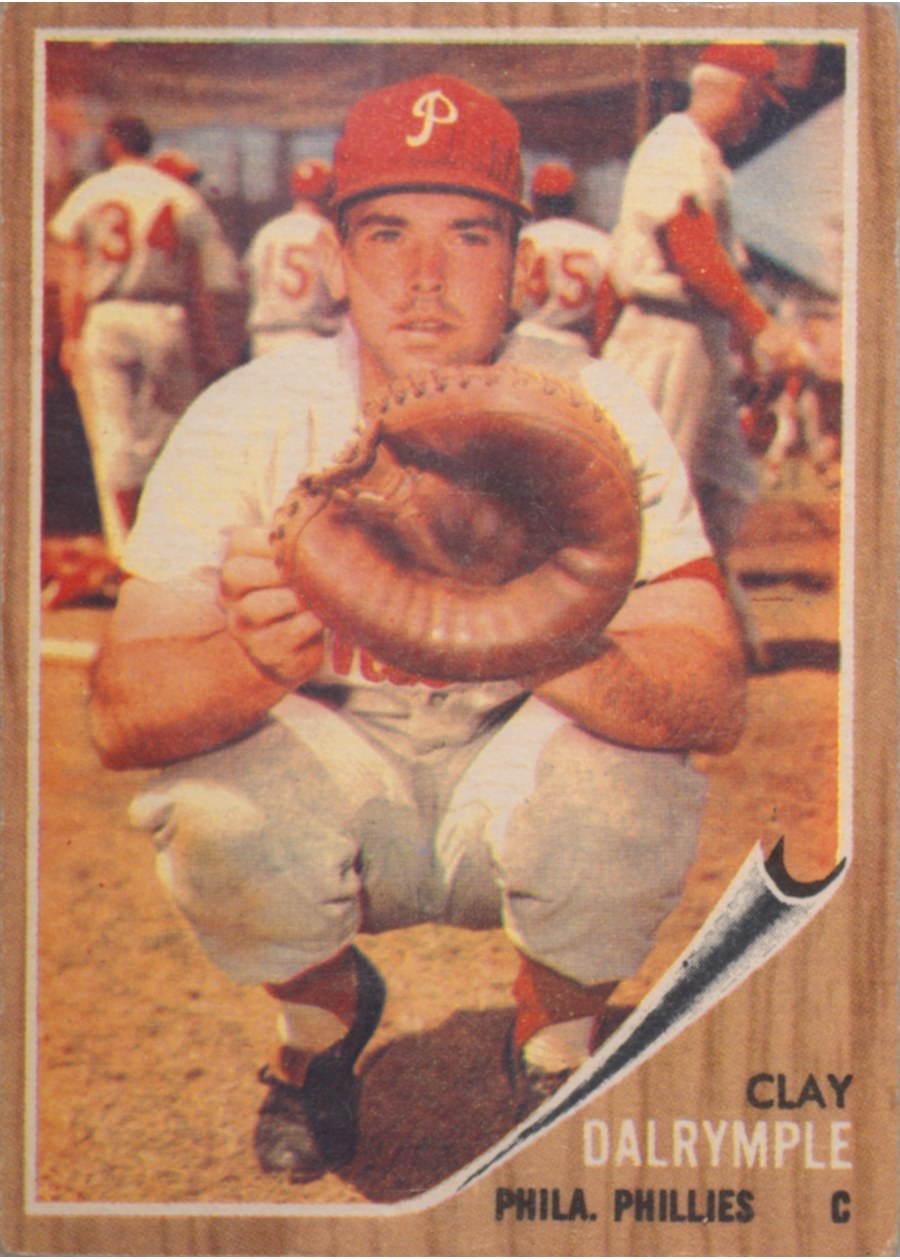
1962 Topps #434 Clay Dalrymple
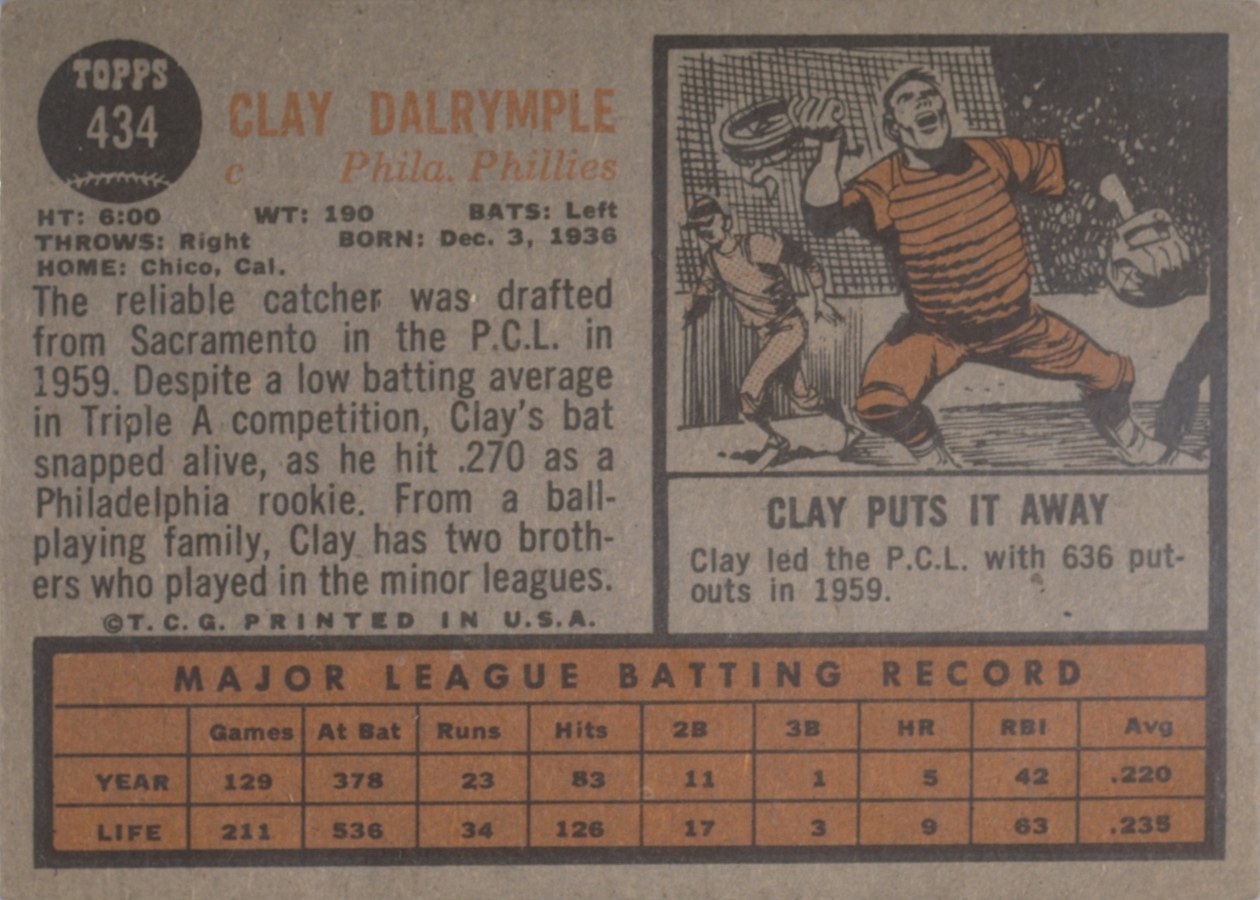
The card back lists a.270 batting average with the Phillies; the correct figure is.272.
Uncorrected error: The back says he hit.270 with the Phillies - it was.272
About Clay Dalrymple
Card #434, a fifth-series number, covers a 1961 season in which Dalrymple played 129 games as Philadelphia's new first-string catcher and hit .220 with 5 home runs and 42 runs batted in. He had come to spring training fighting a mental block on the routine throw back to the pitcher, and his bat stayed cold into midsummer while the Phillies lost 23 games in a row. From midseason on he led the club in hitting, and Mauch came out of the year calling him a better and more confident handler of a game.
Clayton Errol Dalrymple was a left-handed hitting catcher who spent nine seasons with the Philadelphia Phillies and three with the Baltimore Orioles. Philadelphia took him out of the Milwaukee Braves organization in the Rule 5 draft of November 30, 1959, and he reached the majors on April 24, 1960. Valued for his arm and his pitch-calling more than his bat, he twice broke up a no-hit bid in the eighth inning: Juan Marichal's major-league debut in July 1960 and Gaylord Perry's in July 1966. He caught Philadelphia through the 1964 pennant race and its September collapse, and ran off a since-broken league record of 99 consecutive errorless games over 1966 and 1967. He threw out 48.8 percent of the runners who tried to steal on him, 30th on the all-time list. Traded to Baltimore for outfielder Ron Stone on January 20, 1969, he spent three years as a third catcher behind Elrod Hendricks and Andy Etchebarren while the Orioles won three straight American League pennants. He retired after the 1971 season with 710 hits, 55 home runs, 327 runs batted in and a .233 average in 1,079 games, and in 2005 he entered the inaugural class of the Chico Professional Baseball Hall of Fame in his California hometown.
Sources: Wikipedia · SABR BioProject · Baseball-Reference
Graded population (PSA & SGC)
| Grader | Total | 10 | 9 | 8 | 7 | 6 | 5 | 1-4 | Auth |
|---|---|---|---|---|---|---|---|---|---|
| PSA | 204 | 0 | 20 | 78 | 61 | 32 | 5 | 8 | 0 |
| SGC | 16 | 0 | 4 | 3 | 3 | 2 | 3 | 1 | 0 |
Graded population — a scarcity guide, not a price. Snapshot 2026-09-24. Half-grades fold down (8.5→8), and PSA's qualified grades are counted separately from the straight-grade rows shown here. Slabs of the three cards printed #139 are joined by description, never by number alone. PSA registers the green tints as a separate set; a tint's population is listed under that state of the card it belongs to.
Find this card
Search T206 Cards Live auctions Buy It Now on eBay Sold prices
As an eBay Partner Network affiliate, T206Cards.com may earn from qualifying purchases.
Related cards
Team card: #294 Philadelphia Phillies Team
More Philadelphia Phillies cards:
- #17 Johnny Callison
- #46 Jack Baldschun
- #77 Tony Taylor
- #104 Ted Savage
- #111 Dallas Green
- #146 Don Demeter
- #157 Wes Covington
- #181 Paul Brown
- #212 Jim Owens
- #220 Roy Sievers
- #249 Ed Keegan
- #269 Bob Oldis
- #284 Ruben Amaro
- #303 Frank Torre
Frequently asked questions
What is the 1962 Topps #434 card?
It is card #434 of the 600-card 1962 Topps Baseball set, picturing Clay Dalrymple of the Philadelphia Phillies.
Does 1962 Topps #434 have an error?
The back says he hit.270 with the Phillies - it was.272. It was never corrected, so there is no variation to chase - every copy of #434 reads the same way.
How many cards are in the 1962 Topps Baseball set?
600 cards, tracked as 708 collectible states. The numbers run from 1 to 598 with no gaps, but three different cards were printed #139 - two Hal Reniff poses, catalogued 139a and 139b, and the Babe Hits 60 Babe Ruth Special, 139c - so 598 numbers make 600 cards; 93 cards carry catalogued print variations, the series-2 green tints among them, that the master set counts separately.
Sources: Baseball Almanac, Trading Card Database, PSA CardFacts, Cardboard Connection, BaseballCardPedia, The Topps Archives, Baseball-Reference, the SABR BioProject and the National Baseball Hall of Fame, PSA & SGC population reports. Card data compiled and maintained by T206Cards.com. Page last updated 2026-10-03.