
1962 Topps #320 Hank Aaron
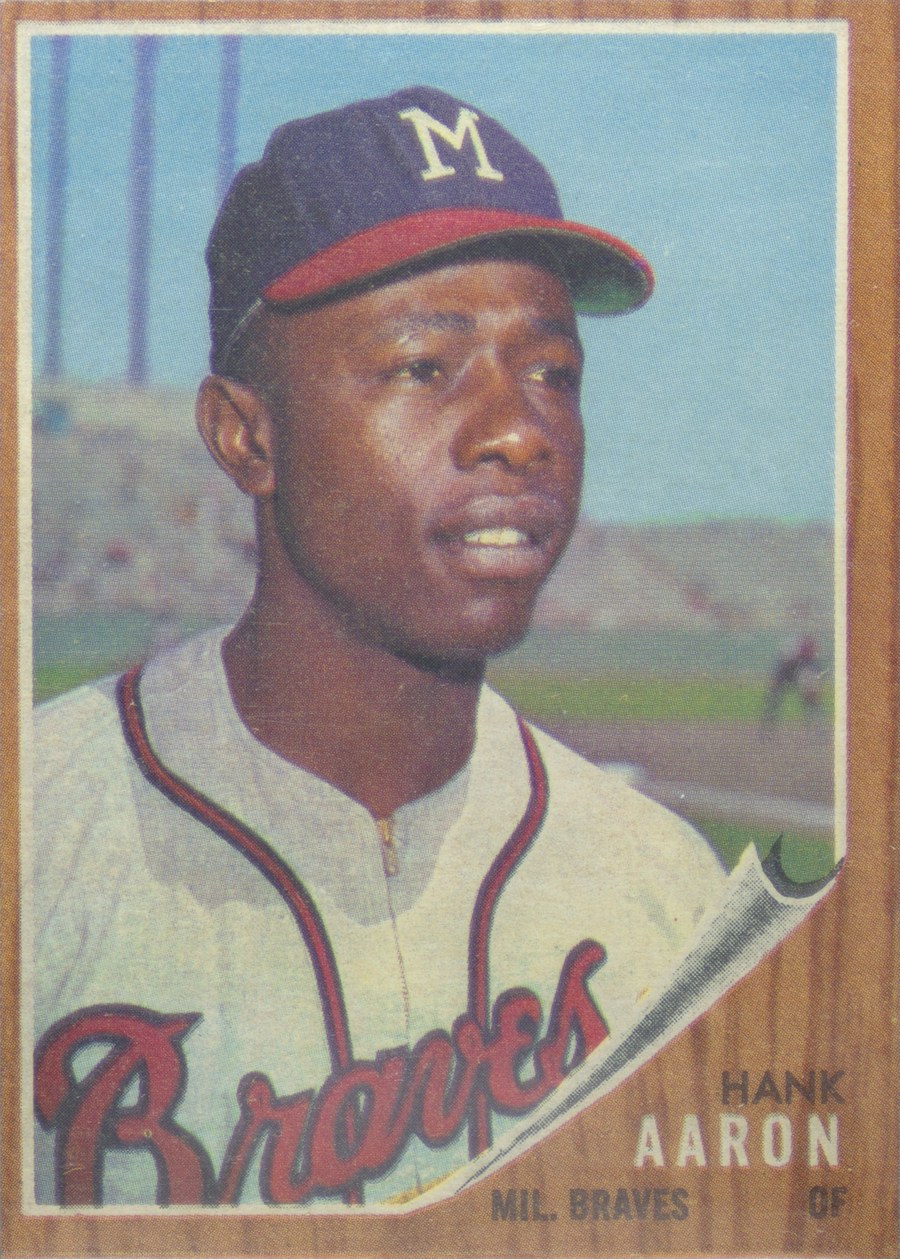
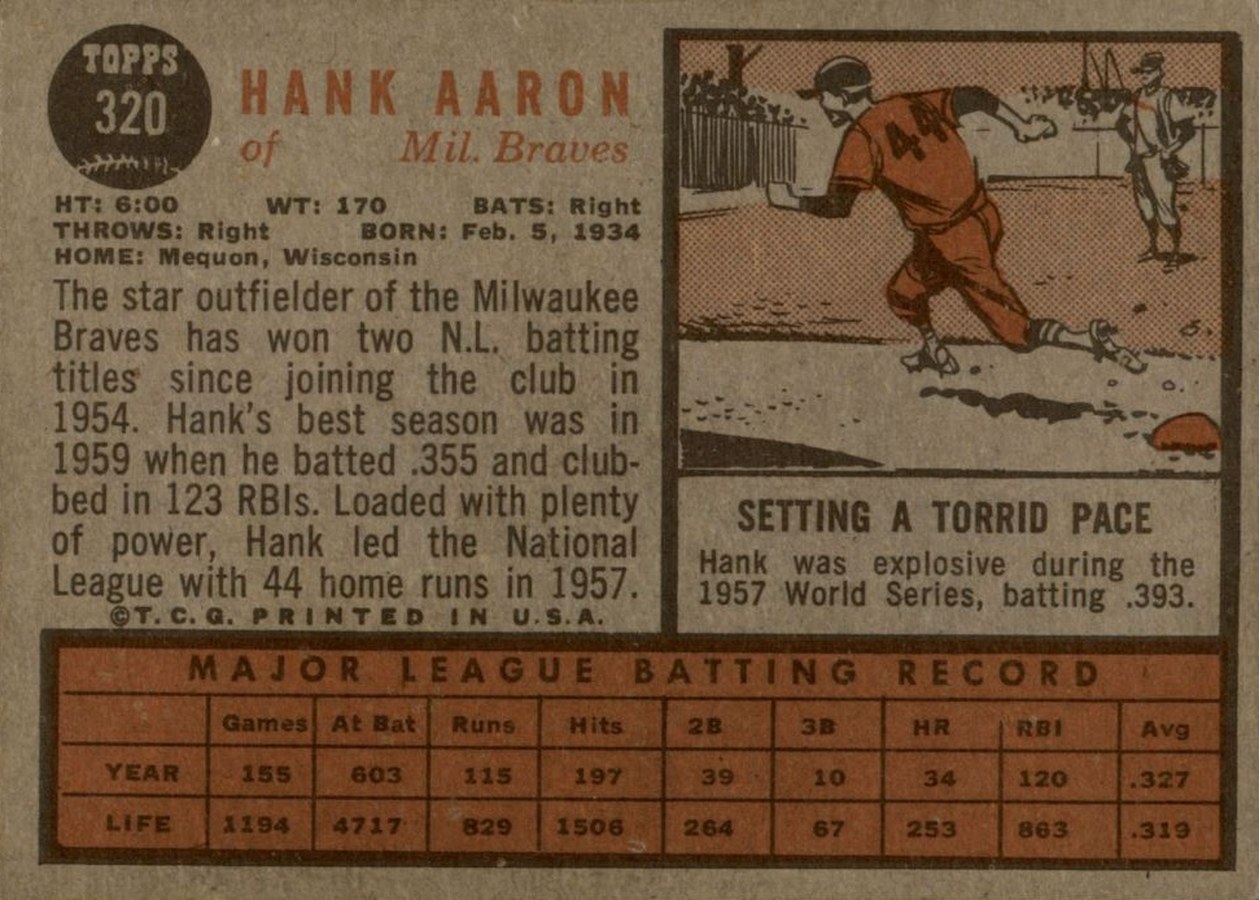
About Hank Aaron
Aaron's series-4 base card #320 carries his 1961 line on the back, and card #394 places him in the National League All-Star run. That season was one of his most complete: .327 with 197 hits, 34 home runs, 120 RBI and a .381 on-base percentage, plus league titles in doubles with 39 and in total bases with 358. Milwaukee slipped to fourth at 83-71 in 1961, then finished fifth in 1962 at 86-76.
Henry Louis Aaron broke in with the Milwaukee Braves in 1954 out of Mobile, Alabama, after a brief stop in the Negro American League with the Indianapolis Clowns. A right fielder who batted and threw right-handed, he spent 21 seasons with the Braves and two with the Milwaukee Brewers, retiring in 1976 with a .305 average, 3,771 hits and 2,297 RBI, still the major-league record. He won the NL batting title twice (1956, 1959), led the league in home runs four times, and took the 1957 NL MVP award as the Braves won the World Series. A 25-time All-Star and three-time Gold Glove winner, he was called Hank by Braves public relations director Don Davidson, who thought the shorter name made the quiet young star more accessible; teammates turned it into Hammerin' Hank. On April 8, 1974, in Atlanta, he hit his 715th home run to pass Babe Ruth as the career leader, a record he held until 2007 while enduring racist threats throughout the pursuit. Aaron finished with 755 home runs and holds career marks for RBI, extra-base hits and total bases. He was elected to the Hall of Fame in 1982, his first year of eligibility, with 97.8% of the vote, and afterward held Braves front office roles, including senior vice president. He died in 2021.
Sources: Wikipedia · SABR BioProject · Baseball-Reference
Graded population (PSA & SGC)
| Grader | Total | 10 | 9 | 8 | 7 | 6 | 5 | 1-4 | Auth |
|---|---|---|---|---|---|---|---|---|---|
| PSA | 3,981 | 0 | 19 | 225 | 579 | 715 | 757 | 1,653 | 33 |
| SGC | 1,967 | 0 | 2 | 23 | 123 | 224 | 393 | 1,084 | 118 |
Graded population — a scarcity guide, not a price. Snapshot 2026-09-24. Half-grades fold down (8.5→8), and PSA's qualified grades are counted separately from the straight-grade rows shown here. Slabs of the three cards printed #139 are joined by description, never by number alone. PSA registers the green tints as a separate set; a tint's population is listed under that state of the card it belongs to.
Find this card
Search T206 Cards Live auctions Buy It Now on eBay Sold prices
As an eBay Partner Network affiliate, T206Cards.com may earn from qualifying purchases.
Related cards
More Hank Aaron in this set: #394 NL All-Stars
Team card: #158 Milwaukee Braves Team
More Milwaukee Braves cards:
- #30 Ed Mathews
- #63 Tony Cloninger
- #76 Howie Bedell
- #100 Warren Spahn
- #109 Bob Shaw
- #130 Frank Bolling
- #174 Carl Willey
- #186 Mack Jones
- #211 Midway Masters
- #218 Joe Torre
- #239 Cecil Butler
- #259 Lou Klimchock
- #265 Joe Adcock
- #289 Mike Krsnich
Frequently asked questions
What is the 1962 Topps #320 card?
It is card #320 of the 600-card 1962 Topps Baseball set, picturing Hank Aaron of the Milwaukee Braves.
What are the key cards in the 1962 Topps set?
The #200 Mickey Mantle anchors the set, with #1 Roger Maris opening it, #300 Willie Mays, #320 Hank Aaron, #5 Sandy Koufax and #10 Bob Clemente (printed under the shortened name Topps used for him) among the stars, #18 Managers' Dream pairing Mantle and Mays, and Mantle again on the #471 AL All-Star card. The #387 Lou Brock and #199 Gaylord Perry rookies head the first-year cards, and #530 Bob Gibson sits in the short-printed high series (#523-598), the hardest cards to find. Behind them come the #218 Joe Torre rookie, Mantle's #318 In Action card and the ten-card Babe Ruth Special.
How many cards are in the 1962 Topps Baseball set?
600 cards, tracked as 708 collectible states. The numbers run from 1 to 598 with no gaps, but three different cards were printed #139 - two Hal Reniff poses, catalogued 139a and 139b, and the Babe Hits 60 Babe Ruth Special, 139c - so 598 numbers make 600 cards; 93 cards carry catalogued print variations, the series-2 green tints among them, that the master set counts separately.
Sources: Baseball Almanac, Trading Card Database, PSA CardFacts, Cardboard Connection, BaseballCardPedia, The Topps Archives, Baseball-Reference, the SABR BioProject and the National Baseball Hall of Fame, PSA & SGC population reports. Card data compiled and maintained by T206Cards.com. Page last updated 2026-10-03.