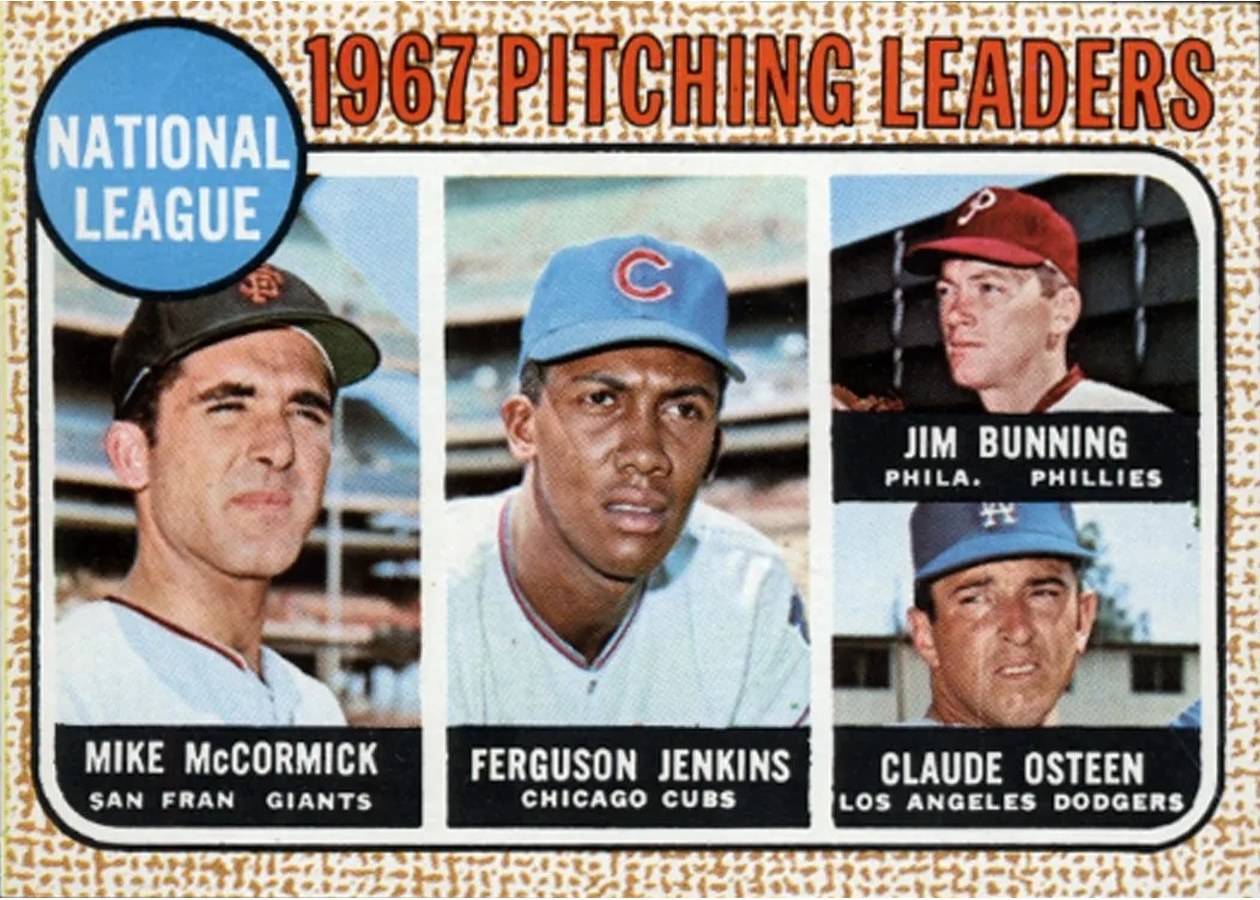
1968 Topps #9 National League 1967 Pitching Leaders - Mike McCormick / Ferguson Jenkins / Jim Bunning / Claude Osteen
On this card: Mike McCormick, Ferguson Jenkins, Jim Bunning, Claude Osteen
About this card
Cards #1-12 are the League Leaders subset: twelve horizontal cards, each listing the top three or four finishers in one 1967 statistical category, the National League card first and the American League card second in each pair.
The story on this card
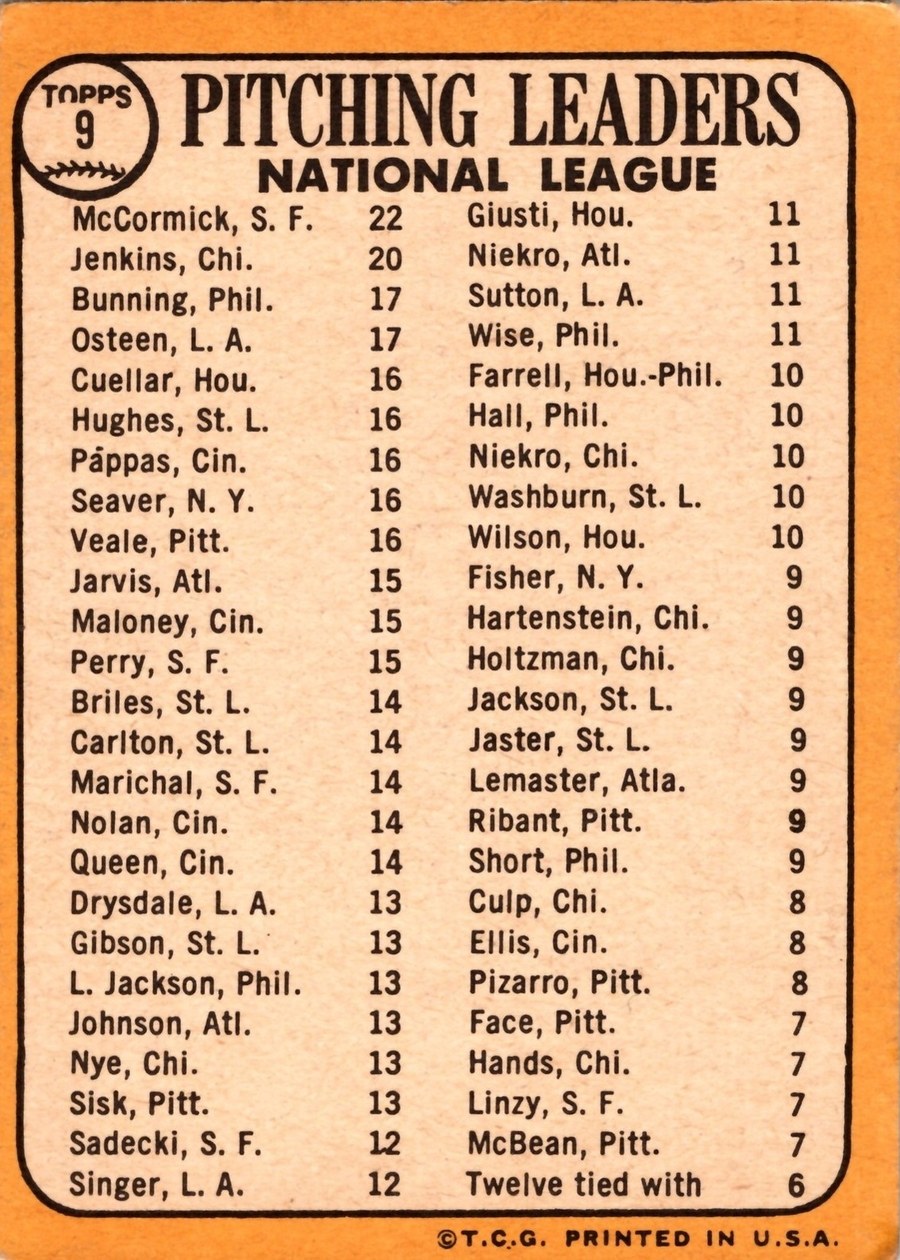
Mike McCormick led the National League with 22 wins in 1967 and won the Cy Young Award, the first won by a Giants pitcher. Ferguson Jenkins went 20-13 for the Cubs and tied Jim Bunning for second in the voting. Bunning, in his fourth year with Philadelphia, went 17-15 with a career-best 2.29 ERA and led the league in shutouts, starts and innings pitched. Claude Osteen went 17-17 for the Dodgers and made his first All-Star team. The back lists all 49 National Leaguers with seven or more wins and ends "Twelve tied with 6".
Mike McCormick was a teenage bonus baby who led the National League in ERA in 1960, lost his fastball to a wrecked shoulder, then rebuilt himself on a screwball and won the 1967 Cy Young Award for the Giants at twenty-nine. Fergie Jenkins was the control artist at the front of the Cubs rotation, winning 20 games in six straight seasons and the 1971 National League Cy Young Award on his way to 284 wins, 3,192 strikeouts and a 1991 Hall of Fame plaque. Jim Bunning won 224 games and threw a no-hitter in each league, for Detroit in 1958 and a perfect game for the Phillies in 1964. He later served as a US Senator from Kentucky and was elected to the Hall of Fame in 1996. Claude Osteen, a left-hander, came to the Dodgers in a December 1964 trade, made three All-Star teams in Los Angeles and shut out the Twins in Game 3 of the 1965 World Series. He finished 196-195 over 18 seasons.
Sources: Wikipedia (Mike McCormick (pitcher)) · Wikipedia (Ferguson Jenkins) · Wikipedia (Jim Bunning) · Wikipedia (Claude Osteen) · SABR BioProject (Mike Mccormick) · SABR BioProject (Fergie Jenkins) · SABR BioProject (Jim Bunning) · SABR BioProject (Claude Osteen) · National Baseball Hall of Fame · Baseball-Reference (Mike McCormick) · Baseball-Reference (Ferguson Jenkins) · Baseball Almanac (Mike McCormick) · Baseball Almanac · Baseball Almanac (Jim Bunning) · Baseball Almanac (Claude Osteen)
Graded population (PSA & SGC)
| Grader | Total | 10 | 9 | 8 | 7 | 6 | 5 | 1-4 | Auth |
|---|---|---|---|---|---|---|---|---|---|
| PSA | 490 | 5 | 61 | 197 | 89 | 58 | 35 | 44 | 1 |
| SGC | 59 | 0 | 5 | 10 | 11 | 7 | 11 | 15 | 0 |
Graded population — a scarcity guide, not a price. Data as of 2026-09-04. Half grades fold down for both graders (8.5→8); PSA qualified slabs (OC, ST, PD, MC and the like) are not counted. Slabs of the yellow team-letter #49 and #66 are 1968 Milton Bradley game cards and are not counted here.
Find this card
Search T206 Cards Shop 1968 Topps cards Live auctions Buy It Now on eBay Sold prices
As an eBay Partner Network affiliate, T206Cards.com may earn from qualifying purchases.
Related cards
Team cards: #477 Philadelphia Phillies, #168 Los Angeles Dodgers
More San Francisco Giants cards:
- #5 National League 1967 Home Run Leaders
- #11 National League 1967 Strikeout Leaders
- #32 Joe Gibbon
- #50 Willie Mays
- #73 Jim Hart
- #85 Gaylord Perry
More Chicago Cubs cards:
- #5 National League 1967 Home Run Leaders
- #11 National League 1967 Strikeout Leaders
- #13 Chuck Hartenstein
- #37 Billy Williams
- #60 Ken Holtzman
- #83 John Stephenson
More Philadelphia Phillies cards:
- #1 National League 1967 Batting Leaders
- #7 National League 1967 ERA Leaders
- #11 National League 1967 Strikeout Leaders
- #17 Dick Hall
- #39 Cookie Rojas
- #59 Don Lock
More Los Angeles Dodgers cards:
Frequently asked questions
What is the 1968 Topps #9 card?
It is card #9 of the 598-card 1968 Topps Baseball set, picturing Mike McCormick, Ferguson Jenkins, Jim Bunning and Claude Osteen. Cards #1-12 are the League Leaders subset: twelve horizontal cards, each listing the top three or four finishers in one 1967 statistical category, the National League card first and the American League card second in each pair.
How many cards are in the 1968 Topps Baseball set?
598 cards plus 8 variations (606 in the master set), issued in seven series. The full breakdown is on the 1968 Topps Baseball checklist page.
Sources: Trading Card Database, PSA CardFacts, Cardboard Connection, BaseballCardPedia, Baseball Almanac, Beckett, Baseball-Reference, the SABR BioProject and the National Baseball Hall of Fame, PSA & SGC population reports. Card data compiled and maintained by T206Cards.com. Page last updated 2026-11-02.