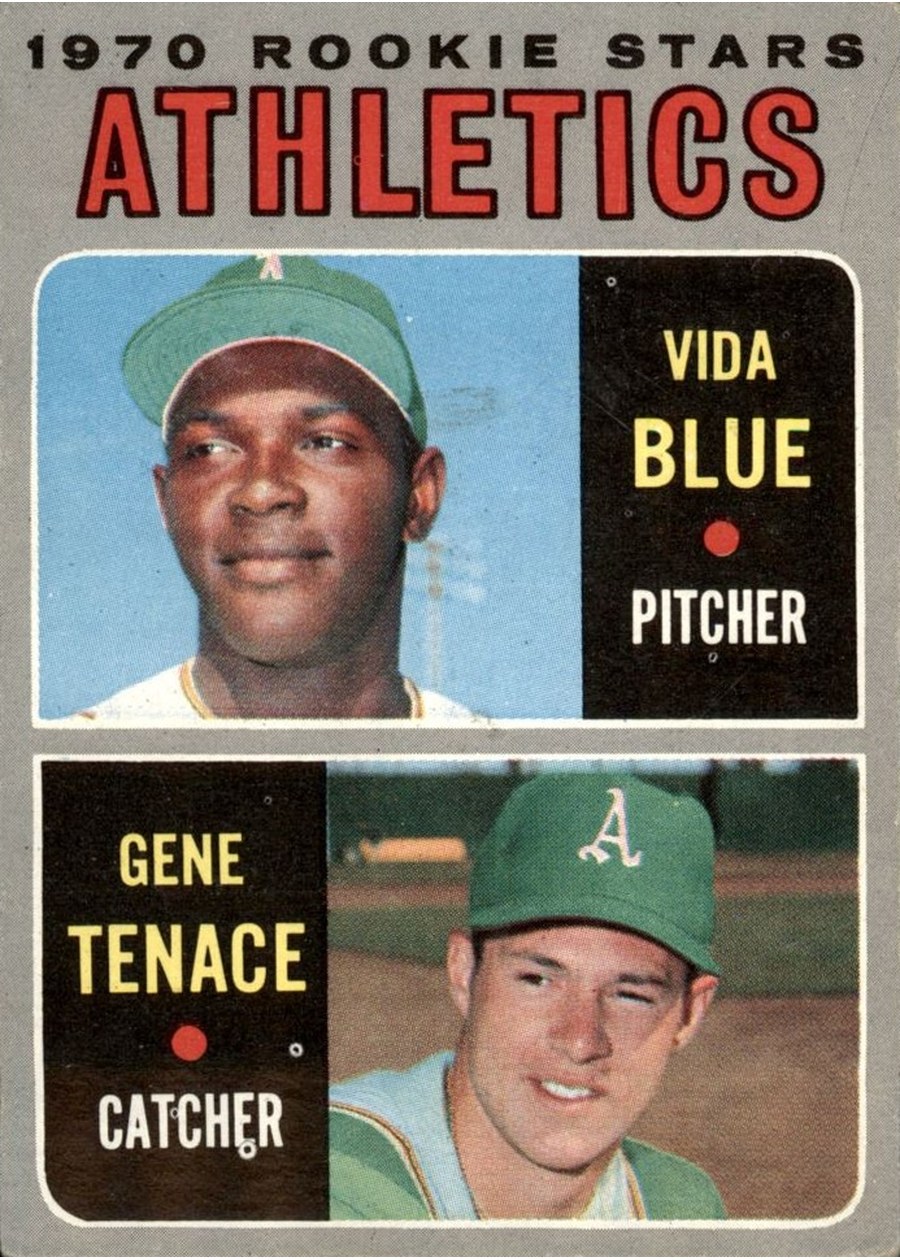
1970 Topps #21 Athletics Rookie Stars - Vida Blue / Gene Tenace
On this card: Vida Blue, Gene Tenace
About this card
This is one of the forty Rookie Stars cards, each showing two or three rookies from one club; #654 (National League) and #702 (American League) each mix three clubs. A Rookie Stars card is a rookie card for the players on it who had no earlier Topps flagship card - on #36, #74, #109, #154, #267, #317, #429, #573, #669 and #683 one of them had already appeared on one, and the rookie-card answer on each card names the players it counts for.
The story on this card
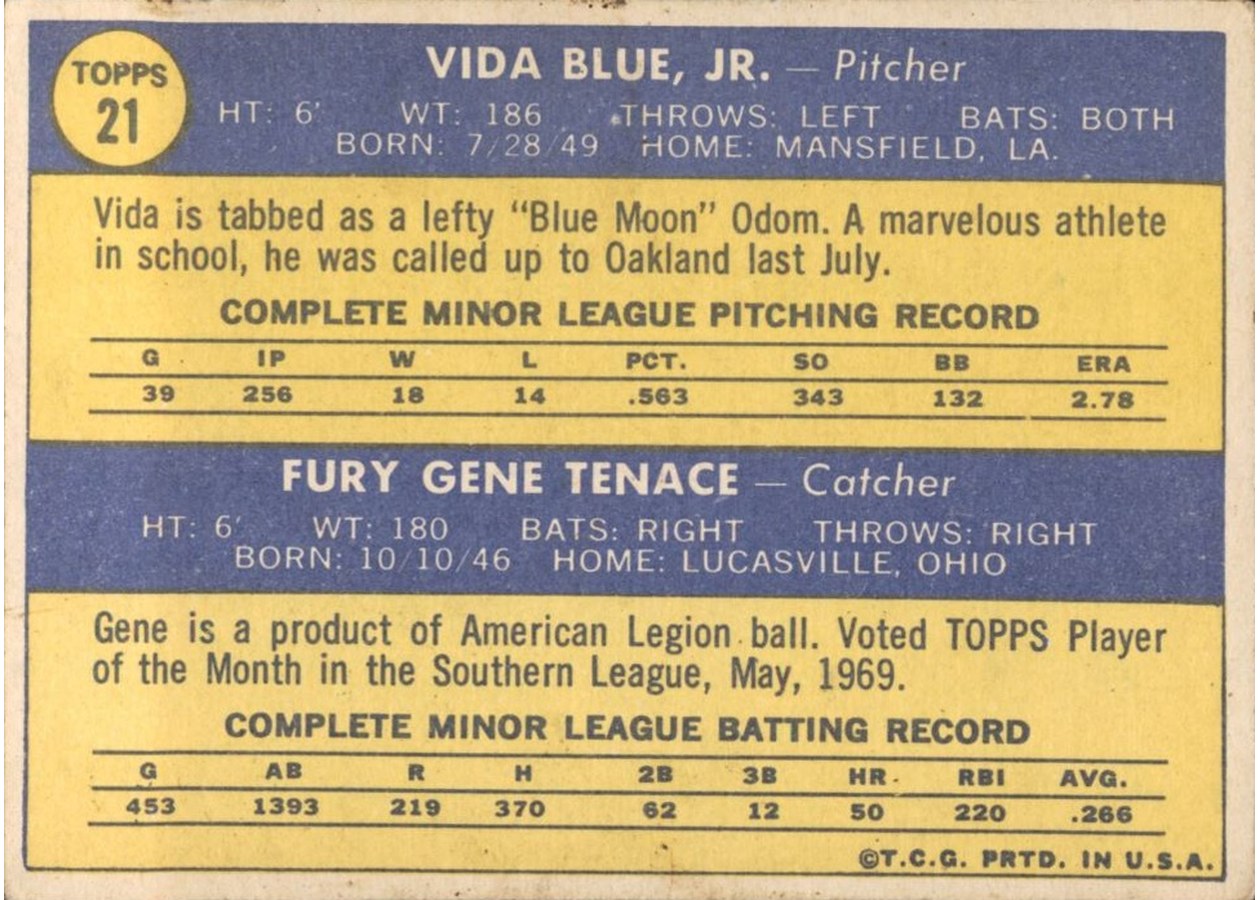
Blue opened 1970 at Iowa in the American Association and reached Oakland in September. He threw a 3-0 one-hit shutout of Kansas City on September 11, then a 6-0 no-hitter against Minnesota ten days later, and finished 2-0 with a 2.09 ERA in six starts. Topps #21 is the Rookie Stars card he shares with Gene Tenace, both printed with the Athletics, in the first series; it is the rookie card of each and one of the key rookie cards of the set. Vida Blue was a hard-throwing left-hander who won the 1971 American League Cy Young Award and MVP Award with Oakland, pitched for three straight World Series winners from 1972 to 1974, and finished 209-161 with the Athletics, Giants and Royals.
Tenace shares Rookie Stars card #21 with Vida Blue, a first-series issue that is a rookie card for both men and one of the key rookie cards of the 1970 set. His 1969 had been 16 games and a .158 average in two stints, with a home run off Detroit's Earl Wilson on June 6. He opened 1970 at Iowa of the American Association, returned to Oakland for the final two months and hit .305 in 105 at-bats. Catcher and first baseman for the Oakland teams that won three straight World Series, 1972 World Series MVP, and a 1975 All-Star. Later a Padres starter, a Cardinals platoon player and a Blue Jays coach.
Sources: Wikipedia (Vida Blue) · Wikipedia (Gene Tenace) · SABR BioProject (Vida Blue) · SABR BioProject (Gene Tenace) · BaseballCardPedia
Graded population (PSA & SGC)
| Grader | Total | 10 | 9 | 8 | 7 | 6 | 5 | 1-4 | Auth |
|---|---|---|---|---|---|---|---|---|---|
| PSA | 1,243 | 0 | 20 | 195 | 268 | 262 | 195 | 302 | 1 |
| SGC | 299 | 0 | 2 | 15 | 33 | 65 | 79 | 104 | 1 |
Graded population — a scarcity guide, not a price. Data as of 2026-10-19. Half grades fold down for both graders (8.5→8); PSA qualified slabs (OC, ST, PD, MC and the like) are not counted.
Find this card
Search T206 Cards Shop 1970 Topps cards Live auctions Buy It Now on eBay Sold prices
As an eBay Partner Network affiliate, T206Cards.com may earn from qualifying purchases.
Related cards
Team card: #631 Oakland Athletics
More Oakland Athletics cards:
- #41 George Lauzerique
- #55 John Odom
- #64 1969 American League RBI Leaders
- #66 1969 American League Home Run Leaders
- #102 Joe Rudi
- #120 Sal Bando
- #140 Reggie Jackson
- #205 Bert Campaneris
- #233 Lew Krausse
- #259 Tommie Reynolds
- #287 Fred Talbot
- #311 Dick Green
- #331 Chuck Dobson
- #381 Athletics 1970 Rookie Stars
Frequently asked questions
What is the 1970 Topps #21 card?
It is card #21 of the 720-card 1970 Topps Baseball set, picturing Vida Blue and Gene Tenace. This is one of the forty Rookie Stars cards, each showing two or three rookies from one club; #654 (National League) and #702 (American League) each mix three clubs. A Rookie Stars card is a rookie card for the players on it who had no earlier Topps flagship card - on #36, #74, #109, #154, #267, #317, #429, #573, #669 and #683 one of them had already appeared on one, and the rookie-card answer on each card names the players it counts for.
Is 1970 Topps #21 a rookie card?
Yes - #21 is a rookie card for every player pictured on it: Vida Blue and Gene Tenace.
How many cards are in the 1970 Topps Baseball set?
720 cards, tracked as 726 collectible states. Numbers run from 1 to 720 with none skipped, issued in seven series - #1-132, #133-263, #264-372, #373-459, #460-546, #547-633 and the high numbers, #634-720; 6 cards, all of them checklists, carry catalogued print variations that the master set counts separately.
Sources: Trading Card Database, PSA CardFacts, BaseballCardPedia, Cardboard Connection, Baseball Almanac, Baseball-Reference, the SABR BioProject and the National Baseball Hall of Fame, PSA & SGC population reports. Card data compiled and maintained by T206Cards.com. Page last updated 2026-10-25.