1970 Topps #455 Brooks Robinson
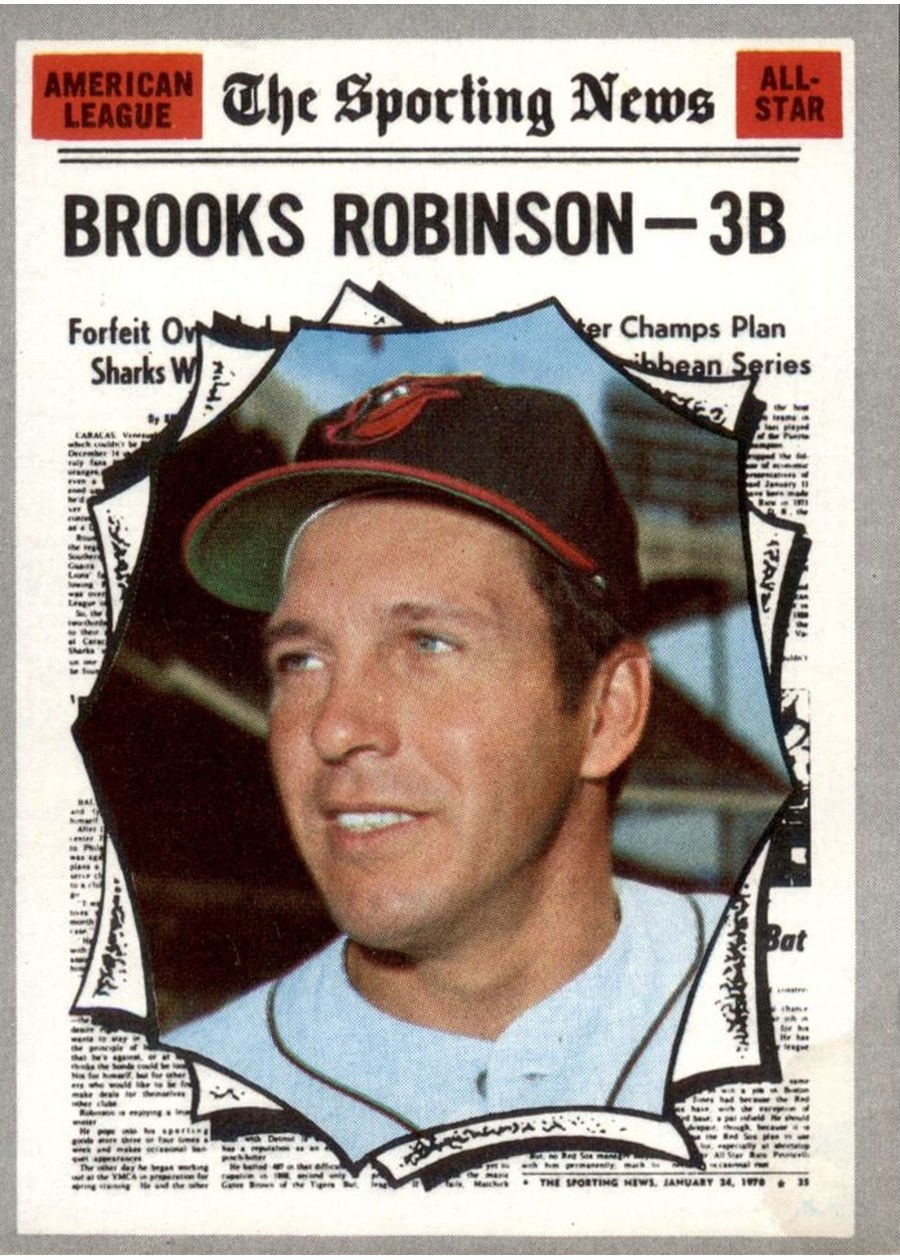
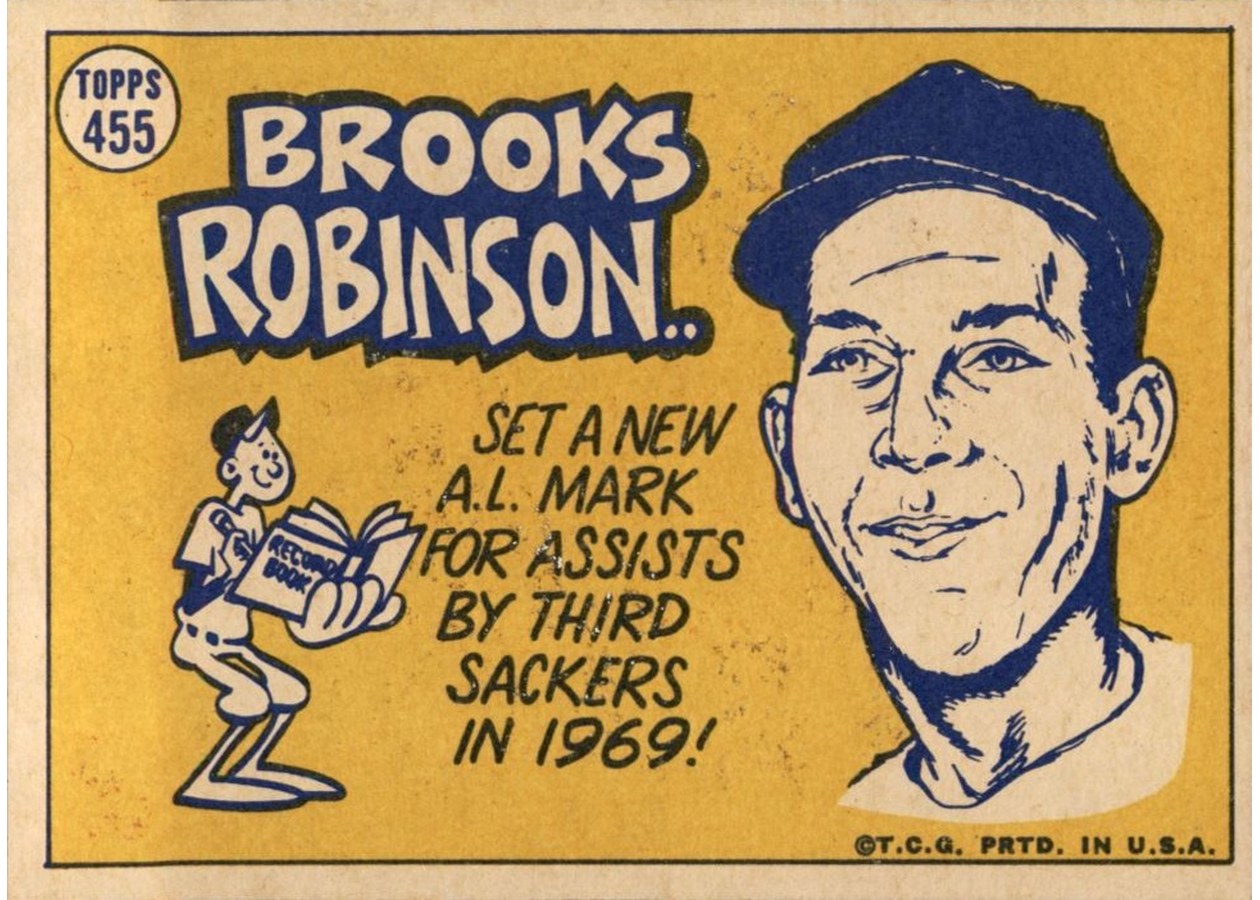
About this card
Cards #450-469 are the twenty All-Star cards, one player to a card, alternating the leagues - National League on the even numbers, American League on the odd - from #450 Willie McCovey to #469 Sam McDowell. Every one of the twenty also has a regular card in the set, and ten of them picture Hall of Famers.
About Brooks Robinson
Robinson hit .234 with 23 home runs and 84 RBI in 1969, an off year for an Orioles team that won 109 games, swept Minnesota in the ALCS and lost the World Series to the Mets. Topps gave him two cards in 1970, #230 in series 2 and #455 in the All-Stars subset, series 4. He rebounded that season to .276 with 18 home runs and 94 RBI as Baltimore won 108 games, then hit the game-winning home run in the World Series opener against Cincinnati.
Brooks Calbert Robinson Jr. spent his entire 23-year career (1955-1977) at third base for the Baltimore Orioles, the club that signed him out of Little Rock, Arkansas, for $4,000 in 1955. Known as the Human Vacuum Cleaner, he is generally regarded as the greatest fielding third baseman in major-league history. He was an All-Star in 15 straight seasons (1960-1974) and won 16 consecutive Gold Gloves (1960-1975), the most by any position player. He still holds the career records for a third baseman in putouts, assists, total chances and double plays. He was the American League Most Valuable Player in 1964, batting .317 with 28 home runs and a league-best 118 RBIs. He played on four AL pennant winners and two World Series champions, in 1966 and 1970. His glovework in the 1970 Series against Cincinnati, where he robbed the Reds again and again while batting .429, earned him the Series MVP award. He finished with a .267 average, 2,848 hits and 268 home runs, all in Baltimore, and his 23 seasons with one team have since been matched only by Carl Yastrzemski. He was elected to the Hall of Fame in 1983 on the first ballot, named on 92 percent of the ballots.
Sources: Wikipedia · SABR BioProject · Baseball-Reference · Baseball Almanac · BaseballCardPedia
Graded population (PSA & SGC)
| Grader | Total | 10 | 9 | 8 | 7 | 6 | 5 | 1-4 | Auth |
|---|---|---|---|---|---|---|---|---|---|
| PSA | 543 | 0 | 17 | 117 | 151 | 99 | 62 | 93 | 4 |
| SGC | 109 | 0 | 0 | 6 | 14 | 22 | 28 | 35 | 4 |
Graded population — a scarcity guide, not a price. Data as of 2026-10-19. Half grades fold down for both graders (8.5→8); PSA qualified slabs (OC, ST, PD, MC and the like) are not counted.
Find this card
Search T206 Cards Shop 1970 Topps cards Live auctions Buy It Now on eBay Sold prices
As an eBay Partner Network affiliate, T206Cards.com may earn from qualifying purchases.
Related cards
More Brooks Robinson in this set: #230
Team card: #387 Baltimore Orioles
More Baltimore Orioles cards:
- #20 Dave McNally
- #45 Dave Johnson
- #64 1969 American League RBI Leaders
- #68 1969 American League ERA Leaders
- #70 1969 American League Pitching Leaders
- #81 Dave May
- #101 Bobby Floyd
- #121 Orioles 1970 Rookie Stars
- #148 Earl Weaver
- #182 Dick Hall
- #199 A.L. Playoff Game 1 - Orioles Win a Squeaker!
- #200 A.L. Playoff Game 2 - Powell Scores Winning Run!
- #201 A.L. Playoff Game 3 - Birds Wrap It Up!
- #202 Orioles Celebrate: Sweep Twins In Three!
Frequently asked questions
What is the 1970 Topps #455 card?
It is card #455 of the 720-card 1970 Topps Baseball set, picturing Brooks Robinson of the Baltimore Orioles. Cards #450-469 are the twenty All-Star cards, one player to a card, alternating the leagues - National League on the even numbers, American League on the odd - from #450 Willie McCovey to #469 Sam McDowell. Every one of the twenty also has a regular card in the set, and ten of them picture Hall of Famers.
How many cards are in the 1970 Topps Baseball set?
720 cards, tracked as 726 collectible states. Numbers run from 1 to 720 with none skipped, issued in seven series - #1-132, #133-263, #264-372, #373-459, #460-546, #547-633 and the high numbers, #634-720; 6 cards, all of them checklists, carry catalogued print variations that the master set counts separately.
Sources: Trading Card Database, PSA CardFacts, BaseballCardPedia, Cardboard Connection, Baseball Almanac, Baseball-Reference, the SABR BioProject and the National Baseball Hall of Fame, PSA & SGC population reports. Card data compiled and maintained by T206Cards.com. Page last updated 2026-10-25.