
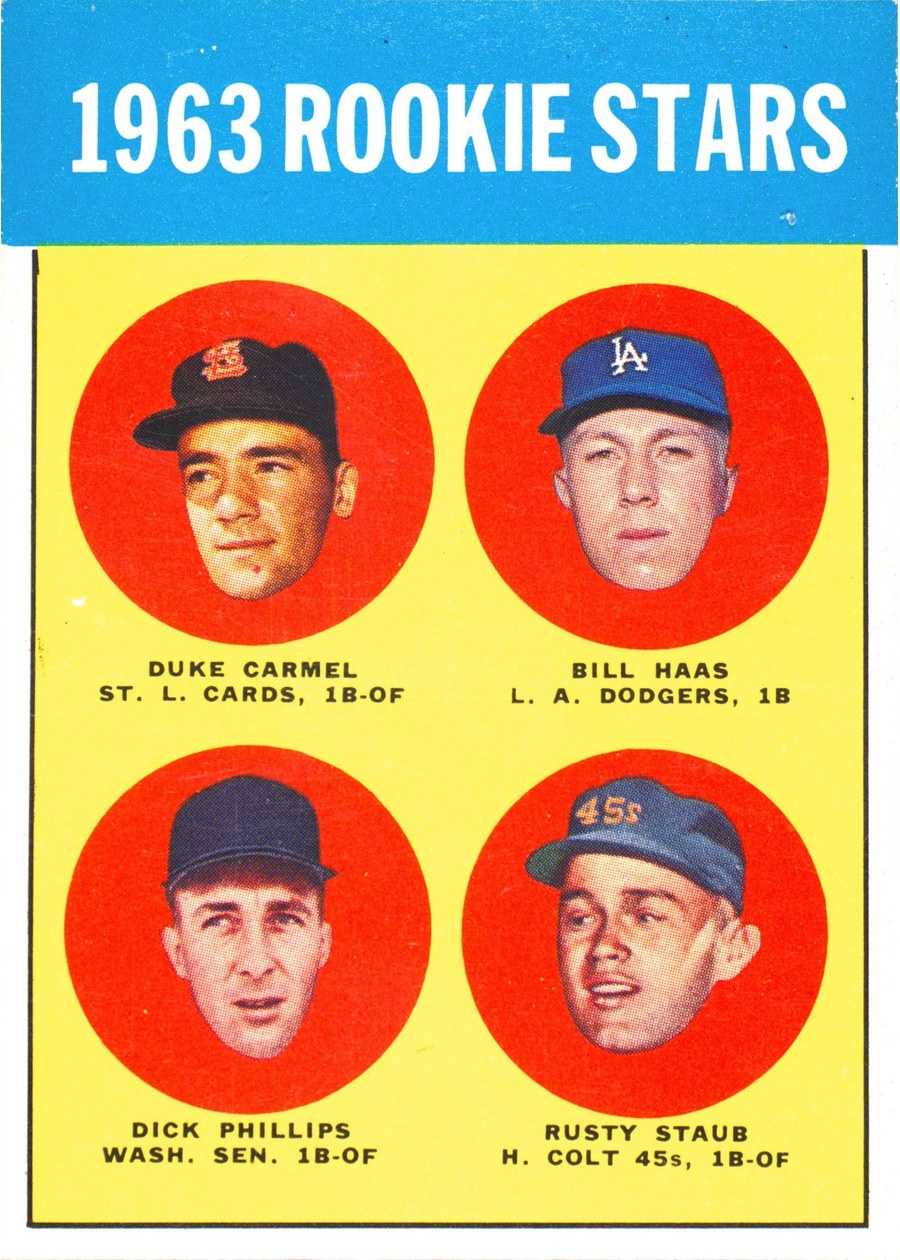
1963 Topps #544 1963 Rookie Stars
On this card: Duke Carmel, Bill Haas, Dick Phillips, Rusty Staub
A rookie card for Rusty Staub, Dick Phillips and Bill Haas, but not for Duke Carmel, who had already played in the majors in 1959 and 1960. Haas never reached the big leagues.
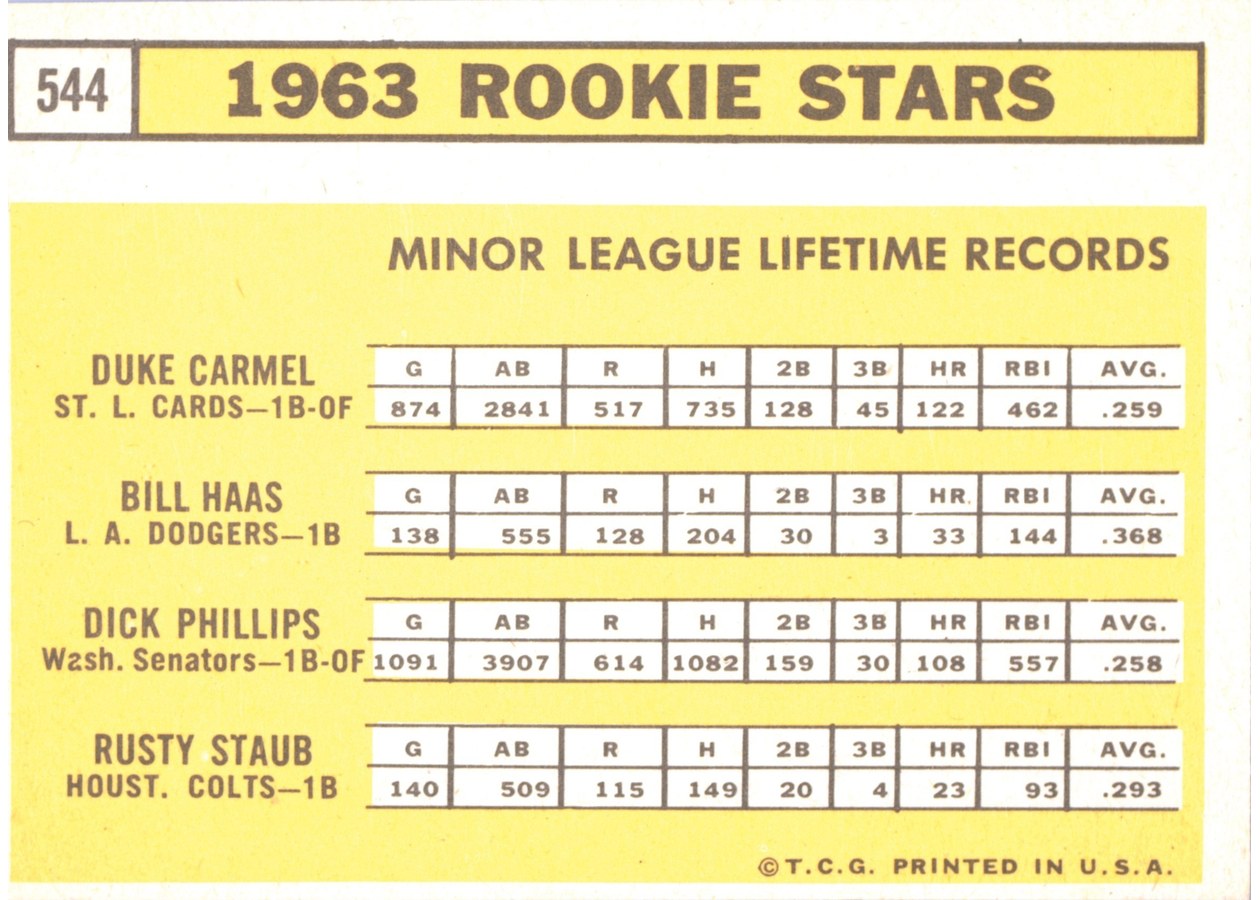
About this card
The twenty Rookie Stars cards, four players each and all titled "1963 Rookie Stars", carry the rookie class - Pete Rose on #537, Willie Stargell on #553, Tony Oliva and Ed Kranepool on #228, Rusty Staub on #544, Bill Freehan on #466 and Dave McNally on #562. Three of them (#169, #208, #544) are rookie cards for only some of the men pictured.
The story on this card
Carmel shares 1963 Topps #544, a four-player Rookie Stars card, with Bill Haas, Dick Phillips and Rusty Staub, the quartet representing the Cardinals, Dodgers, Senators and Colt .45's. It sits in the seventh series, a high number from the scarce closing run of the set. It is the rookie card of Staub, Phillips and Haas; Carmel's first big-league games had come in 1959 and 1960. Haas, the young Dodgers first baseman pictured, never did appear in a big-league game at all. Carmel opened 1963 in St. Louis, tied a game on April 16 with a ninth-inning pinch-hit homer off Elroy Face, and was dealt to the Mets on July 29 for outfielder Jacke Davis. Duke Carmel, a 6'3" left-handed outfielder and first baseman born in New York City, played all or parts of four major league seasons between 1959 and 1965 for the Cardinals, Mets and Yankees, batting .211 with four home runs in 124 games.
In spring training 1963 the 19-year-old Haas, a Philadelphia sandlot signee, got a look from the Dodgers after his 1962 minor league batting title with Class C Reno, working out at first base with veterans like Moose Skowron, but he did not crack the 25-man roster; after the season the Mets picked him up in a special draft for $30,000. This high number, #544 in Topps' seventh and final 1963 print series, is a four-player Rookie Stars subset Haas shares with Duke Carmel, Dick Phillips, and Rusty Staub, and it is a recognized rookie card. A Philadelphia sandlot signee who won a 1962 minor league batting title with Reno, but glove concerns and a demoralizing slide through the Mets' farm system kept the power-hitting outfielder from ever reaching the majors.
After his contract was sold from the Giants to the Washington Senators, Phillips became a regular first baseman, starting 68 games there in 1963. Topps' high-number series 7 gave him his first card, #544, a multi-player Rookie Stars issue shared with Duke Carmel, Bill Haas and Rusty Staub, and it is recognized as his rookie card. A Racine, Wisconsin native and Marine Corps Korean War veteran, Phillips reached the majors in 1962 after winning the Pacific Coast League MVP award, then spent parts of four seasons as a big-league first baseman with the Giants and Senators.
Staub's recognised rookie card sits deep in the high numbers, in Topps' seventh series, as one of four young players crowded onto a single Rookie Stars panel alongside Duke Carmel, Bill Haas and Dick Phillips. The Houston Colt .45s had handed the 19-year-old right field and the cleanup spot on Opening Day against the defending National League champion Giants, and he went 1-for-3 with a walk and an RBI. His first big-league home run took until June 3, a game-winner off Don Drysdale, and he finished at .224 with 6 homers and 45 RBIs in 150 games, only the second big-league rookie since 1900 to play 150 games as a teenager, after Bob Kennedy in 1940. A $100,000 bonus baby out of New Orleans who grew into a six-time All-Star outfielder, beloved in Montreal as Le Grand Orange and remembered for 2,716 career hits.
Sources: Wikipedia (Duke Carmel) · Wikipedia (Dick Phillips) · Wikipedia (Rusty Staub) · SABR BioProject (Dick Phillips) · SABR BioProject (Rusty Staub)
Graded population (PSA & SGC)
| Grader | Total | 10 | 9 | 8 | 7 | 6 | 5 | 1-4 | Auth |
|---|---|---|---|---|---|---|---|---|---|
| PSA | 843 | 0 | 10 | 146 | 231 | 210 | 121 | 122 | 3 |
| SGC | 223 | 0 | 0 | 12 | 44 | 42 | 74 | 45 | 6 |
Graded population — a scarcity guide, not a price. Snapshot 2026-09-24. Half-grades fold down (8.5→8), and PSA's qualified grades are counted separately from the straight-grade rows shown here.
Find this card
Search T206 Cards Live auctions Buy It Now on eBay Sold prices
As an eBay Partner Network affiliate, T206Cards.com may earn from qualifying purchases.
Related cards
Team cards: #524 St. Louis Cardinals, #337 Los Angeles Dodgers, #131 Washington Senators, #312 Houston Colt .45's
More St. Louis Cardinals cards:
- #1 1962 National League Batting Leaders
- #5 1962 National League E.R.A. Leaders
- #9 1962 National League Strikeout Leaders
- #22 Curt Simmons
- #49 Dal Maxvill
- #54 1963 Rookie Stars
More Los Angeles Dodgers cards:
- #1 1962 National League Batting Leaders
- #5 1962 National League E.R.A. Leaders
- #7 1962 National League Pitching Leaders
- #9 1962 National League Strikeout Leaders
- #11 Lee Walls
- #53 Joe Moeller
More Washington Senators cards:
- #2 1962 American League Batting Leaders
- #47 Don Lock
- #69 Bud Zipfel
- #94 Bob Schmidt
- #121 Jim Hannan
- #149 Marv Breeding
More Houston Colt .45's cards:
- #9 1962 National League Strikeout Leaders
- #24 Bob Bruce
- #45 Bob Aspromonte
- #77 Al Spangler
- #99 Jim Umbricht
- #119 Bob Lillis
Frequently asked questions
What is the 1963 Topps #544 card?
It is card #544 of the 576-card 1963 Topps Baseball set, picturing Duke Carmel, Bill Haas, Dick Phillips and Rusty Staub. The twenty Rookie Stars cards, four players each and all titled "1963 Rookie Stars", carry the rookie class - Pete Rose on #537, Willie Stargell on #553, Tony Oliva and Ed Kranepool on #228, Rusty Staub on #544, Bill Freehan on #466 and Dave McNally on #562. Three of them (#169, #208, #544) are rookie cards for only some of the men pictured.
Is #544 a rookie card for all four players?
No. It is the rookie card of Rusty Staub, Dick Phillips and Bill Haas, but not of Duke Carmel, whose first Topps card is 1960 #120 and who had already played in the majors in 1959 and 1960. Haas never reached the big leagues.
Why is #544 harder to find?
It is a high number card from the seventh print series, #512-576 - the last and scarcest run in the set. Price guides often band the highs as #523-576, but the printing break falls between #511 and #512.
How many cards are in the 1963 Topps Baseball set?
576 cards, tracked as 583 collectible states. The numbers run from 1 to 576 with no gaps and no number used twice, and seven cards carry a catalogued print variation - three checklists, the two Rookie Stars cards also printed with a "1962" heading, and the #341 Jack Baldschun and #454 Art Fowler print states - that the master set counts separately.
Sources: Trading Card Database, PSA CardFacts, Cardboard Connection, BaseballCardPedia, The Topps Archives, Baseball-Reference, the SABR BioProject and the National Baseball Hall of Fame, PSA & SGC population reports. Card data compiled and maintained by T206Cards.com. Page last updated 2026-10-03.