
1967 Topps #100 Frank Robinson
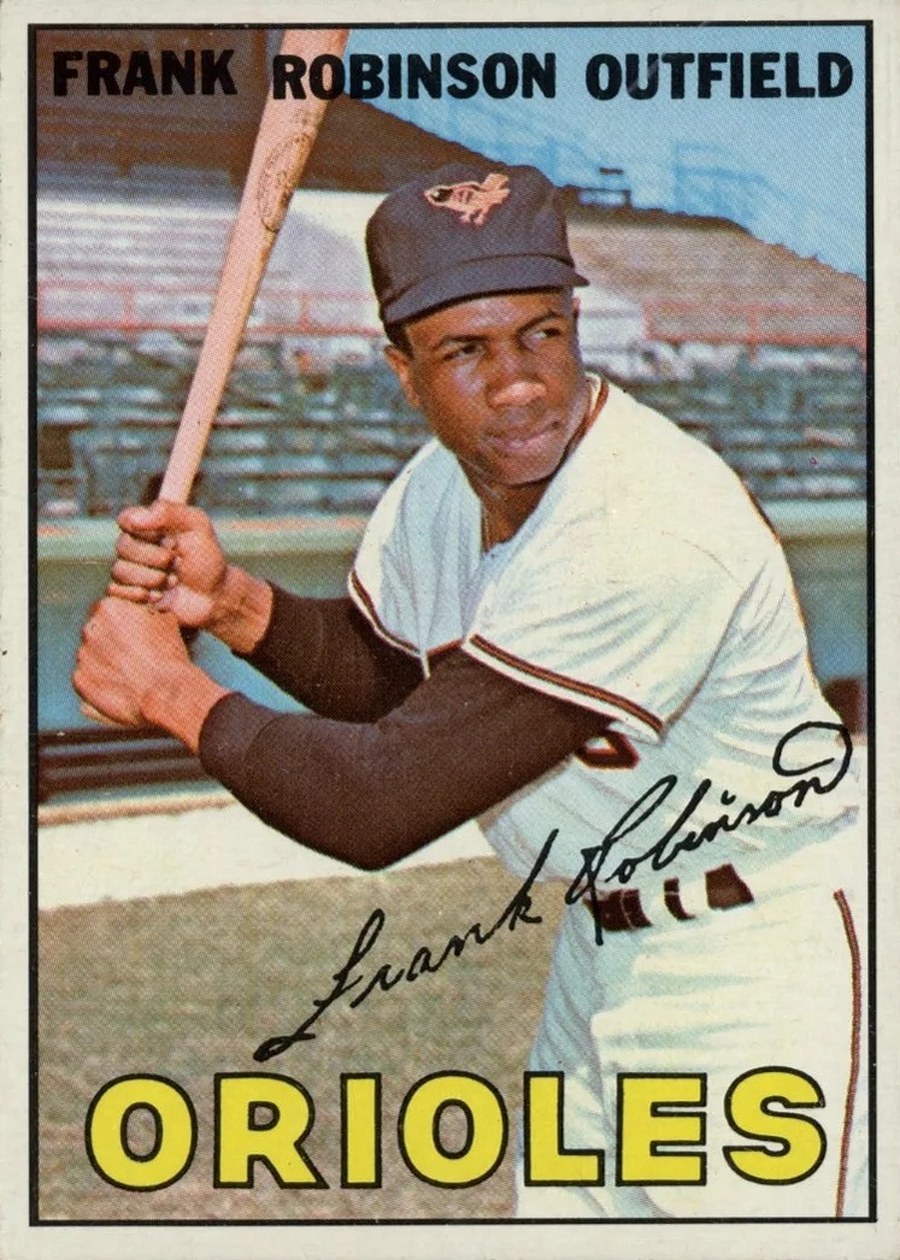
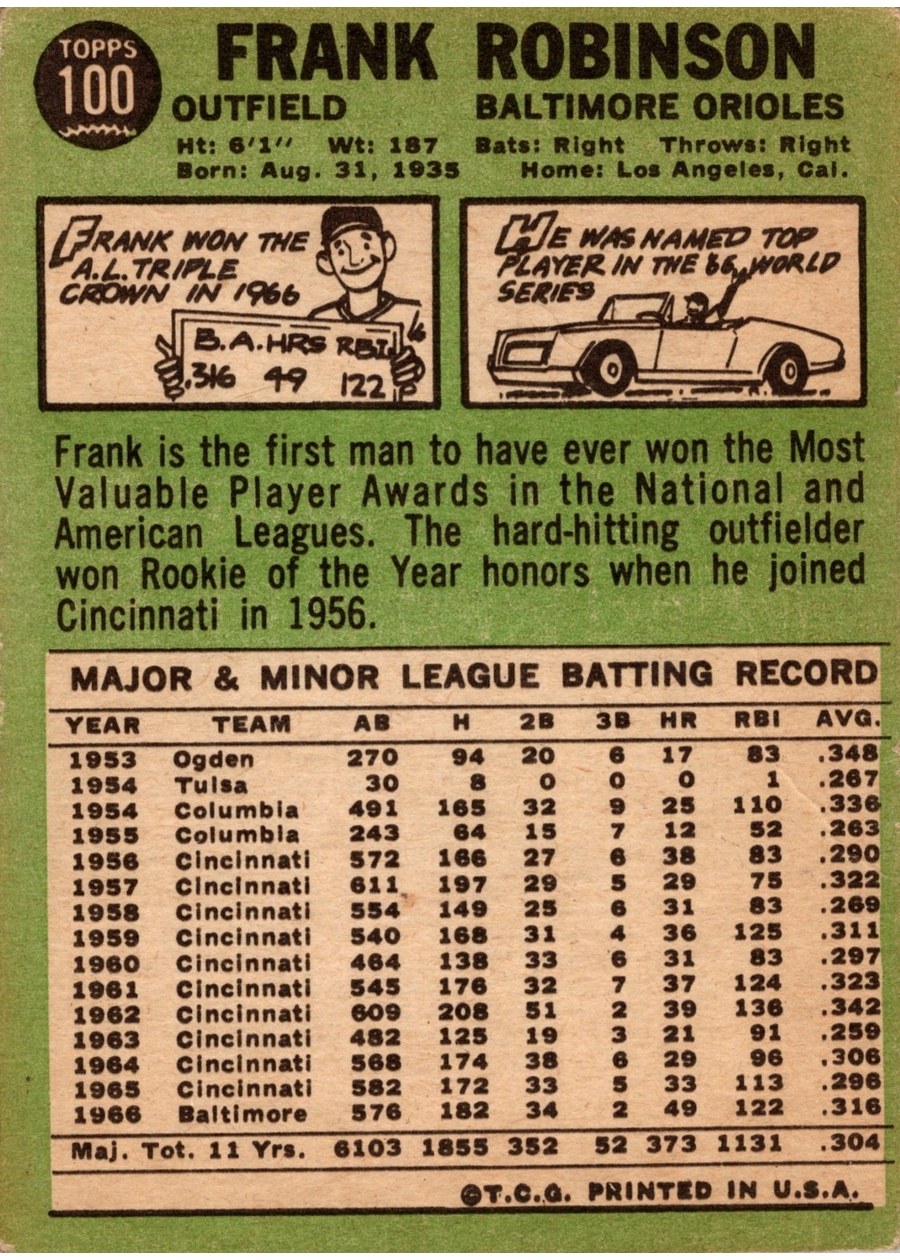
Robinson's own card, issued as the reigning Triple Crown winner and American League Most Valuable Player.
About Frank Robinson
His five 1967 cards, and the #62 checklist that pictures him, all point back at 1966, when he became the only Oriole to win the Triple Crown, took the MVP award unanimously, and homered twice off Don Drysdale in the World Series sweep, once for the lone run of the 1-0 clincher. Card #1, "The Champs," a double print, sets him with manager Hank Bauer and Brooks Robinson; #100 is his own. He heads all three hitting-leader cards: #239 over Tony Oliva and Al Kaline, #241 and #243 over Harmon Killebrew and Boog Powell.
Frank Robinson reached the majors with the Cincinnati Redlegs on April 17, 1956, at age 20, and his 38 home runs that summer tied Wally Berger's 1930 rookie record and carried him to National League Rookie of the Year. He became Cincinnati's franchise player, driving the Reds to the 1961 pennant and winning that year's National League Most Valuable Player award. Reds owner Bill DeWitt, calling him "an old 30," traded him to Baltimore on December 9, 1965 for pitchers Milt Pappas and Jack Baldschun and outfielder Dick Simpson, a deal that became shorthand for a one-sided trade. Robinson answered with the 1966 American League Triple Crown, a unanimous MVP award that made him the first man honored in both leagues, and a World Series MVP as the Orioles swept the Dodgers. Three more pennants and a second title followed by 1971. A 14-time All-Star who curled his body over the plate and slid in spikes first, he was nicknamed "the Judge" for presiding over Baltimore's clubhouse kangaroo court, and left the game after 21 seasons with 586 home runs and 2,943 hits. In 1975 he became the majors' first Black manager, with Cleveland, and entered the National Baseball Hall of Fame in 1982.
Sources: Wikipedia · SABR BioProject · Baseball-Reference · Baseball Almanac · BaseballCardPedia
Graded population (PSA & SGC)
| Grader | Total | 10 | 9 | 8 | 7 | 6 | 5 | 1-4 | Auth |
|---|---|---|---|---|---|---|---|---|---|
| PSA | 2,430 | 7 | 136 | 522 | 461 | 403 | 291 | 604 | 6 |
| SGC | 661 | 0 | 12 | 46 | 103 | 130 | 148 | 203 | 19 |
Graded population — a scarcity guide, not a price. Data as of 2026-09-04. Half grades fold down for both graders (8.5→8); PSA qualified slabs (OC, ST, PD, MC and the like) are not counted. PSA registers a row for every one of the 624 states; SGC lists no separate row for the #149 white-streak state.
Find this card
Search T206 Cards Shop 1967 Topps cards Live auctions Buy It Now on eBay Sold prices
As an eBay Partner Network affiliate, T206Cards.com may earn from qualifying purchases.
Related cards
More Frank Robinson in this set: #1 Combo, #239 League Leaders, #241 League Leaders, #243 League Leaders
Team card: #302 Baltimore Orioles
More Baltimore Orioles cards:
- #1 The Champs
- #22 Gene Brabender
- #38 Bob Johnson
- #60 Luis Aparicio
- #82 Steve Barber
- #125 Moe Drabowsky
- #141 John Miller
- #151 World Series Game #1 - Moe Mows Down 11
- #152 World Series Game #2 - Palmer Blanks Dodgers
- #153 World Series Game #3 - Blair's Homer Defeats L.A.
- #154 World Series Game #4 - Orioles Win 4th Straight
- #155 World Series - The Winners Celebrate
- #163 Vic Roznovsky
- #180 Curt Blefary
Frequently asked questions
What is the 1967 Topps #100 card?
It is card #100 of the 609-card 1967 Topps Baseball set, picturing Frank Robinson of the Baltimore Orioles.
Is 1967 Topps #100 a scarce card?
It is a double print card (26 cards: #1, #30, #100, the #531 checklist and 22 high numbers). Cards printed twice on the sheet, so more plentiful than their neighbours: #1 The Champs, #30 Al Kaline, #100 Frank Robinson, the #531 seventh-series checklist, and 22 of the 76 high numbers (#534, 537, 539, 542, 547, 548, 550, 551, 554, 556, 559, 562, 564, 566, 569, 582, 588, 589, 596, 599, 601, 608), Carew #569 included. A high number that is also a double print is easier than its series suggests.
How many cards are in the 1967 Topps Baseball set?
609 cards, tracked as 624 collectible states. Numbers run from 1 to 609 without a gap - no number was skipped and none was used twice - and 15 cards carry catalogued print variations that the master set counts separately.
Sources: Trading Card Database, PSA CardFacts, Cardboard Connection, Baseball Almanac, BaseballCardPedia, Baseball-Reference, the SABR BioProject and the National Baseball Hall of Fame, PSA & SGC population reports. Card data compiled and maintained by T206Cards.com. Page last updated 2026-10-12.