
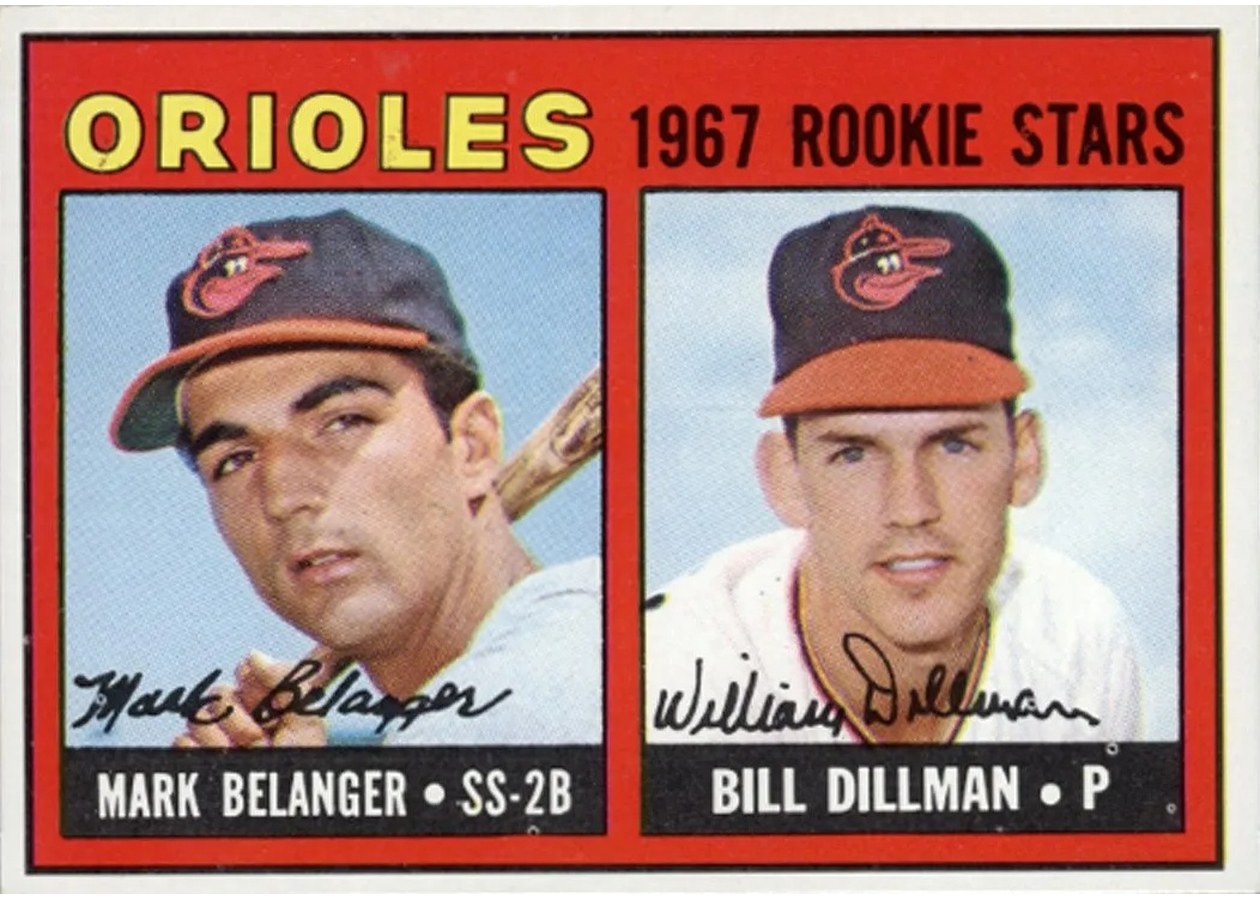
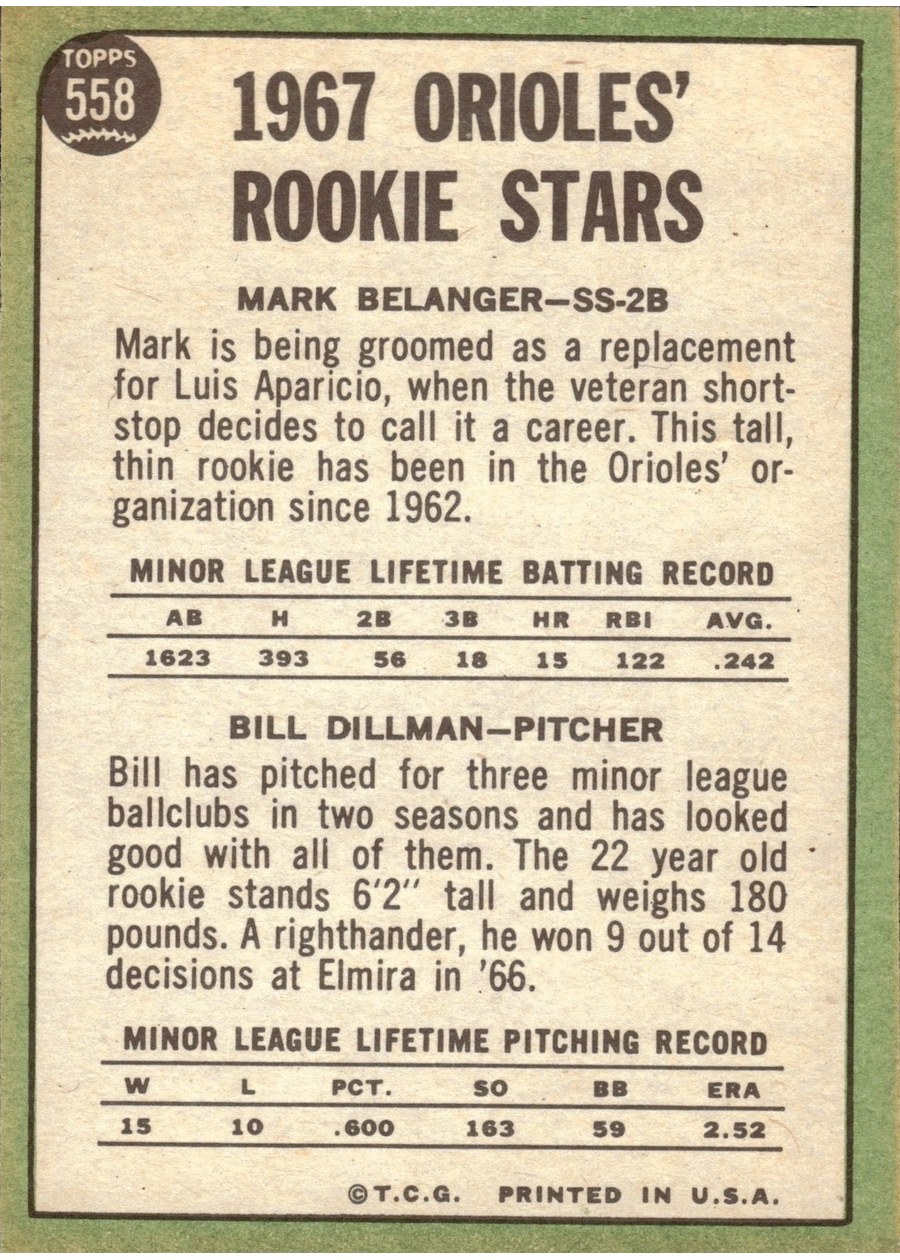
1967 Topps #558 Orioles Rookie Stars - Mark Belanger / Bill Dillman
On this card: Mark Belanger, Bill Dillman
About this card
This is one of the 43 Rookie Stars cards in the set, each pairing two prospects. Thirty-nine are titled by club; #569, #576, #587 and #592 carry a league title and cover two clubs each.
The story on this card
Card #558, "Orioles 1967 Rookie Stars," is Belanger's rookie card, shared with fellow Baltimore rookie Bill Dillman. It sits in the seventh series, the set's high numbers. The card follows a 1966 divided between Triple-A Rochester, where he batted .262, and eight late-season games in Baltimore that brought three hits in 19 at-bats. He did not appear in that autumn's World Series sweep of the Dodgers. Mark Belanger was Baltimore's slick-fielding shortstop of the late 1960s and 1970s, an eight-time Gold Glove winner and 1970 World Series champion whose glovework outshone a weak bat before he became a Major League Baseball Players Association leader.
Dillman's only Topps rookie card is #558, an Orioles Rookie Stars issue shared with fellow Baltimore rookie Mark Belanger and printed in the seventh series, the set's high numbers. He earned it with a full rookie workload: 32 games, 15 of them starts, a 5-9 record, 4.35 ERA, 69 strikeouts, two complete games and three saves across 124 innings. His April 14 debut was the highlight, five hitless relief innings behind starter Tom Phoebus, a strikeout of Phil Roof, and the win. Bill Dillman was a Wake Forest right-hander who won his 1967 major league debut with five no-hit innings of relief for Baltimore, split that rookie season between starting and the bullpen, and closed out his career with the 1970 Montreal Expos.
Sources: Wikipedia (Mark Belanger) · Wikipedia (Bill Dillman) · SABR BioProject · National Baseball Hall of Fame · Baseball Almanac (Mark Belanger)
Graded population (PSA & SGC)
| Grader | Total | 10 | 9 | 8 | 7 | 6 | 5 | 1-4 | Auth |
|---|---|---|---|---|---|---|---|---|---|
| PSA | 800 | 1 | 38 | 198 | 207 | 156 | 80 | 106 | 14 |
| SGC | 210 | 0 | 2 | 18 | 44 | 38 | 49 | 46 | 13 |
Graded population — a scarcity guide, not a price. Data as of 2026-09-04. Half grades fold down for both graders (8.5→8); PSA qualified slabs (OC, ST, PD, MC and the like) are not counted. PSA registers a row for every one of the 624 states; SGC lists no separate row for the #149 white-streak state.
Find this card
Search T206 Cards Shop 1967 Topps cards Live auctions Buy It Now on eBay Sold prices
As an eBay Partner Network affiliate, T206Cards.com may earn from qualifying purchases.
Related cards
Team card: #302 Baltimore Orioles
More Baltimore Orioles cards:
- #1 The Champs
- #22 Gene Brabender
- #38 Bob Johnson
- #60 Luis Aparicio
- #82 Steve Barber
- #100 Frank Robinson
- #125 Moe Drabowsky
- #141 John Miller
- #151 World Series Game #1 - Moe Mows Down 11
- #152 World Series Game #2 - Palmer Blanks Dodgers
- #153 World Series Game #3 - Blair's Homer Defeats L.A.
- #154 World Series Game #4 - Orioles Win 4th Straight
- #155 World Series - The Winners Celebrate
- #163 Vic Roznovsky
Frequently asked questions
What is the 1967 Topps #558 card?
It is card #558 of the 609-card 1967 Topps Baseball set, picturing Mark Belanger and Bill Dillman. This is one of the 43 Rookie Stars cards in the set, each pairing two prospects. Thirty-nine are titled by club; #569, #576, #587 and #592 carry a league title and cover two clubs each.
Is 1967 Topps #558 a rookie card?
Yes - #558 is a rookie card for every player pictured on it: Mark Belanger and Bill Dillman.
Why is #558 harder to find?
It is a high number card from the seventh and last print series, #534-609 - the scarce end of the set, holding both Hall of Fame rookies (Carew #569, Seaver #581). Twenty-two of the 76 are accepted double prints, so scarcity varies card by card inside the run.
How many cards are in the 1967 Topps Baseball set?
609 cards, tracked as 624 collectible states. Numbers run from 1 to 609 without a gap - no number was skipped and none was used twice - and 15 cards carry catalogued print variations that the master set counts separately.
Sources: Trading Card Database, PSA CardFacts, Cardboard Connection, Baseball Almanac, BaseballCardPedia, Baseball-Reference, the SABR BioProject and the National Baseball Hall of Fame, PSA & SGC population reports. Card data compiled and maintained by T206Cards.com. Page last updated 2026-10-12.