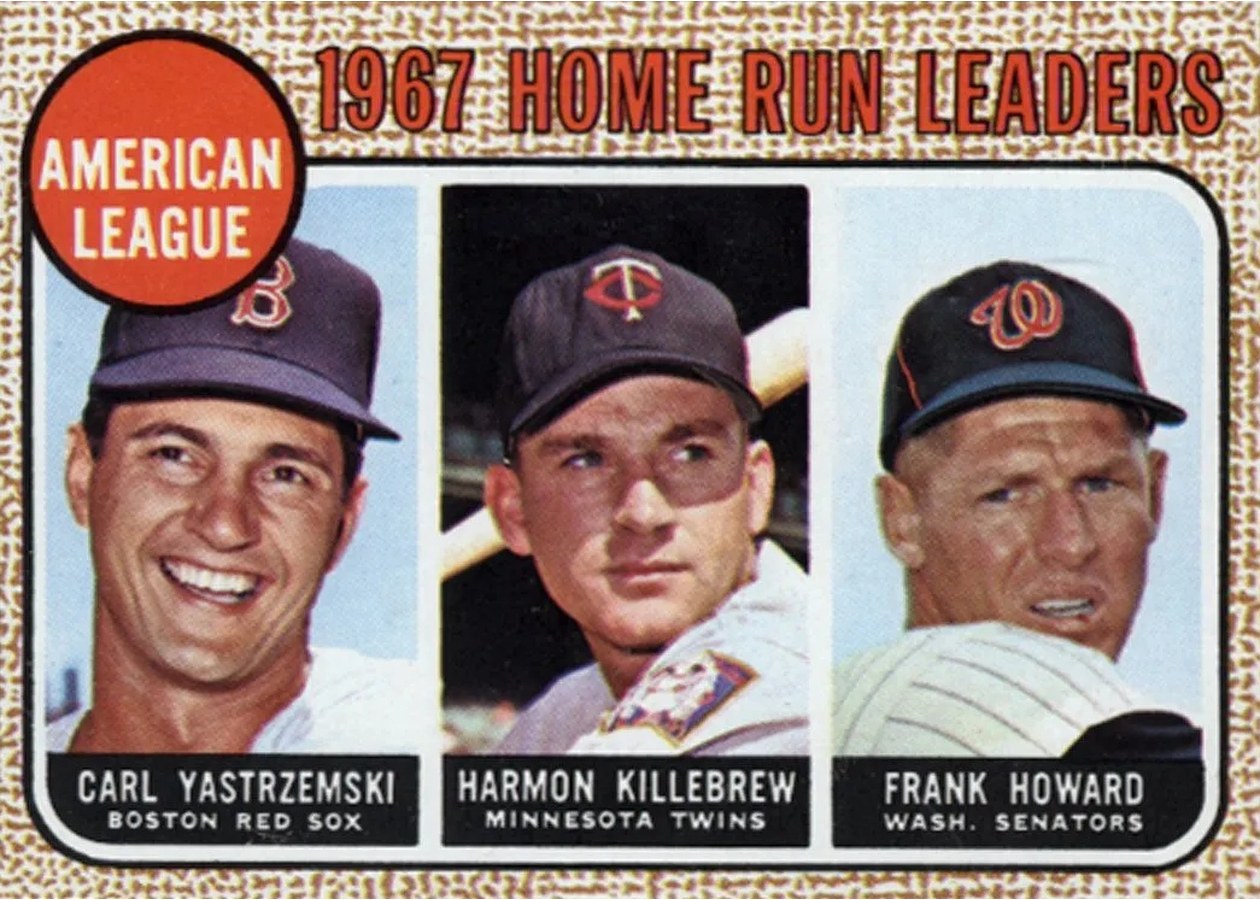
1968 Topps #6 American League 1967 Home Run Leaders - Carl Yastrzemski / Harmon Killebrew / Frank Howard
On this card: Carl Yastrzemski, Harmon Killebrew, Frank Howard
About this card
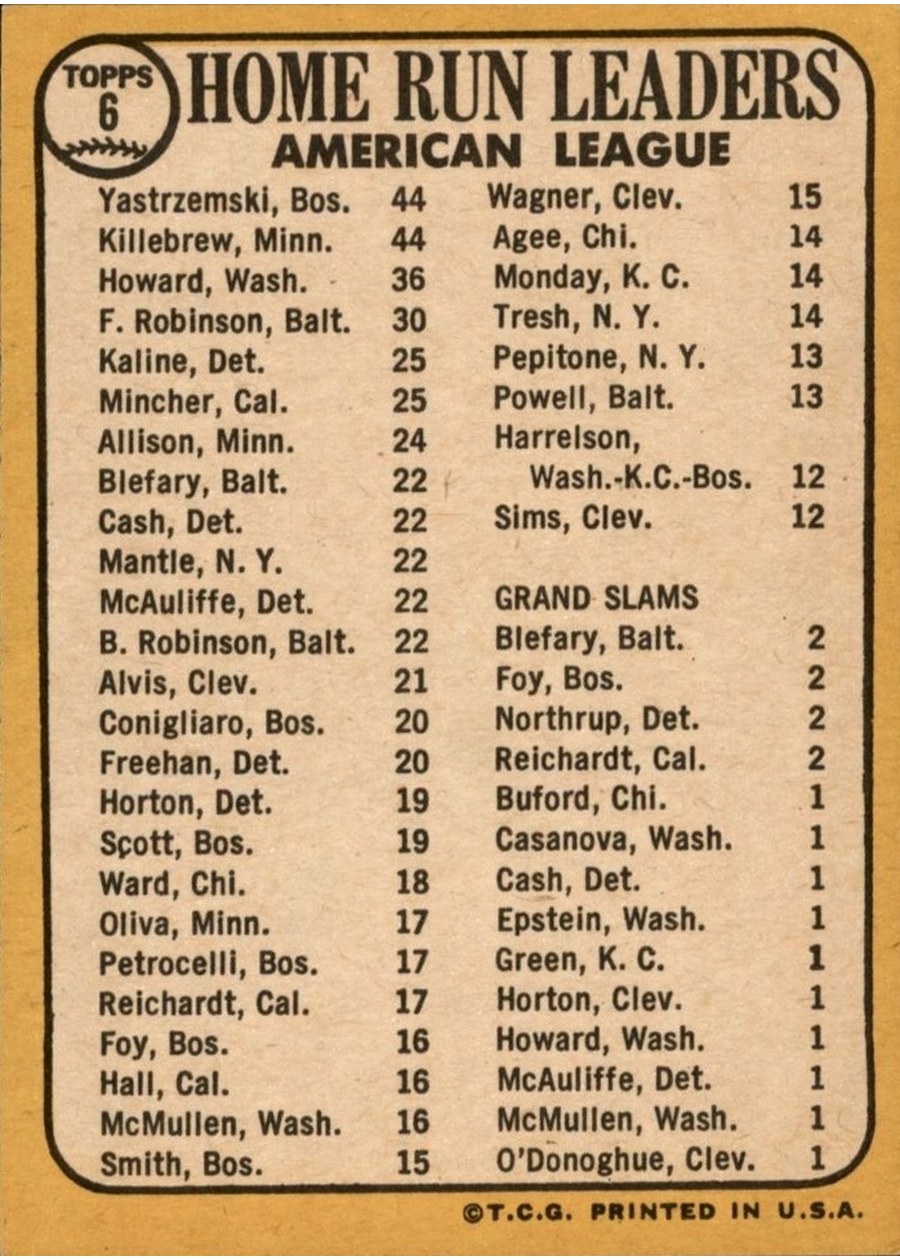
Cards #1-12 are the League Leaders subset: twelve horizontal cards, each listing the top three or four finishers in one 1967 statistical category, the National League card first and the American League card second in each pair.
The story on this card
Card #6 in the 1968 Topps set is the American League Home Run Leaders board, recapping the 1967 race: Carl Yastrzemski and Harmon Killebrew tied atop the league with 44 home runs apiece, while Frank Howard placed third with 36. Yastrzemski's 44 came as part of his Triple Crown season, the second of his three career batting titles, as he carried Boston to the pennant. Killebrew reached his 44 for the Twins in a Minnesota club that finished tied with Detroit for second, one game back. Howard's 36 for the Senators was then a career high for him and a sign of the power he would lean on through his Washington years. The card puts Yastrzemski, Killebrew and Howard on one board together, crediting each man with his club: Red Sox, Twins and Senators.
Carl Yastrzemski, 'Yaz,' gave Boston all 23 of his seasons, following Ted Williams in left field. He won the 1967 Triple Crown and MVP, three batting titles, seven Gold Gloves and 18 All-Star nods, and reached Cooperstown on the first ballot in 1989. Harmon Killebrew was the Twins' quiet, powerfully built slugger of the 1960s, a six-time American League home run champion who hit more homers in the decade than anyone else and won the 1969 AL Most Valuable Player award. Frank Howard - the 6-foot-7 "Capital Punisher": 1960 NL Rookie of the Year with the Dodgers, then the Washington Senators' one-man box office, twice an American League home run champion and a four-time All-Star.
Sources: Wikipedia (Carl Yastrzemski) · Wikipedia (Harmon Killebrew) · Wikipedia (Frank Howard) · SABR BioProject (Harmon Killebrew) · SABR BioProject (Frank Howard) · Baseball Almanac (Carl Yastrzemski) · Baseball Almanac (Harmon Killebrew) · Baseball Almanac (Frank Howard)
Graded population (PSA & SGC)
| Grader | Total | 10 | 9 | 8 | 7 | 6 | 5 | 1-4 | Auth |
|---|---|---|---|---|---|---|---|---|---|
| PSA | 1,159 | 13 | 76 | 342 | 264 | 156 | 102 | 202 | 4 |
| SGC | 217 | 0 | 6 | 29 | 40 | 32 | 44 | 66 | 0 |
Graded population — a scarcity guide, not a price. Data as of 2026-09-04. Half grades fold down for both graders (8.5→8); PSA qualified slabs (OC, ST, PD, MC and the like) are not counted. Slabs of the yellow team-letter #49 and #66 are 1968 Milton Bradley game cards and are not counted here.
Find this card
Search T206 Cards Shop 1968 Topps cards Live auctions Buy It Now on eBay Sold prices
As an eBay Partner Network affiliate, T206Cards.com may earn from qualifying purchases.
Related cards
Team card: #137 Minnesota Twins
More Boston Red Sox cards:
- #2 American League 1967 Batting Leaders
- #4 American League 1967 RBI Leaders
- #10 American League 1967 Pitching Leaders
- #12 American League 1967 Strikeout Leaders
- #26 Darrell Brandon
- #43 Gary Bell
More Minnesota Twins cards:
- #4 American League 1967 RBI Leaders
- #10 American League 1967 Pitching Leaders
- #12 American League 1967 Strikeout Leaders
- #28 Ted Uhlaender
- #44 Frank Kostro
- #64 Jim Merritt
More Washington Senators cards:
- #31 Ed Stroud
- #49 Ed Brinkman
- #66 Casey Cox
- #96 Senators 1968 Rookie Stars
- #116 Ken McMullen
- #131 Frank Bertaina
Frequently asked questions
What is the 1968 Topps #6 card?
It is card #6 of the 598-card 1968 Topps Baseball set, picturing Carl Yastrzemski, Harmon Killebrew and Frank Howard. Cards #1-12 are the League Leaders subset: twelve horizontal cards, each listing the top three or four finishers in one 1967 statistical category, the National League card first and the American League card second in each pair.
How many cards are in the 1968 Topps Baseball set?
598 cards, tracked as 606 collectible states. The numbers run from 1 to 598 without a gap and no printed number carries two different cards; eight cards - six of the seven checklists, #10 AL Pitching Leaders and #400 Mike McCormick - carry a catalogued print variation that the master set counts separately.
Sources: Trading Card Database, PSA CardFacts, Cardboard Connection, BaseballCardPedia, Baseball Almanac, Beckett, Baseball-Reference, the SABR BioProject and the National Baseball Hall of Fame, PSA & SGC population reports. Card data compiled and maintained by T206Cards.com. Page last updated 2026-10-12.