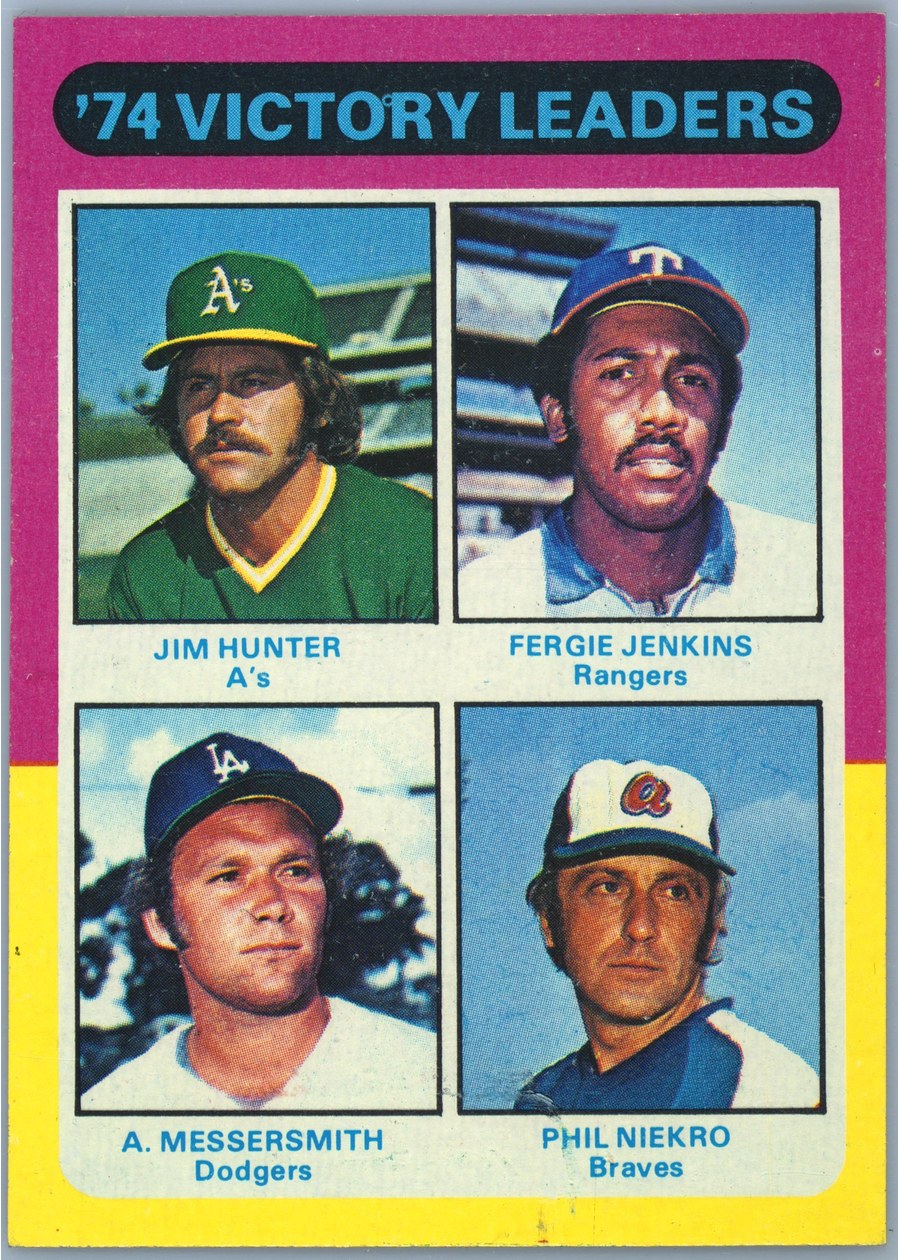
1975 Topps #310 1974 Victory Leaders
Part of the 1974 League Leaders subset (#306-313).
About this card
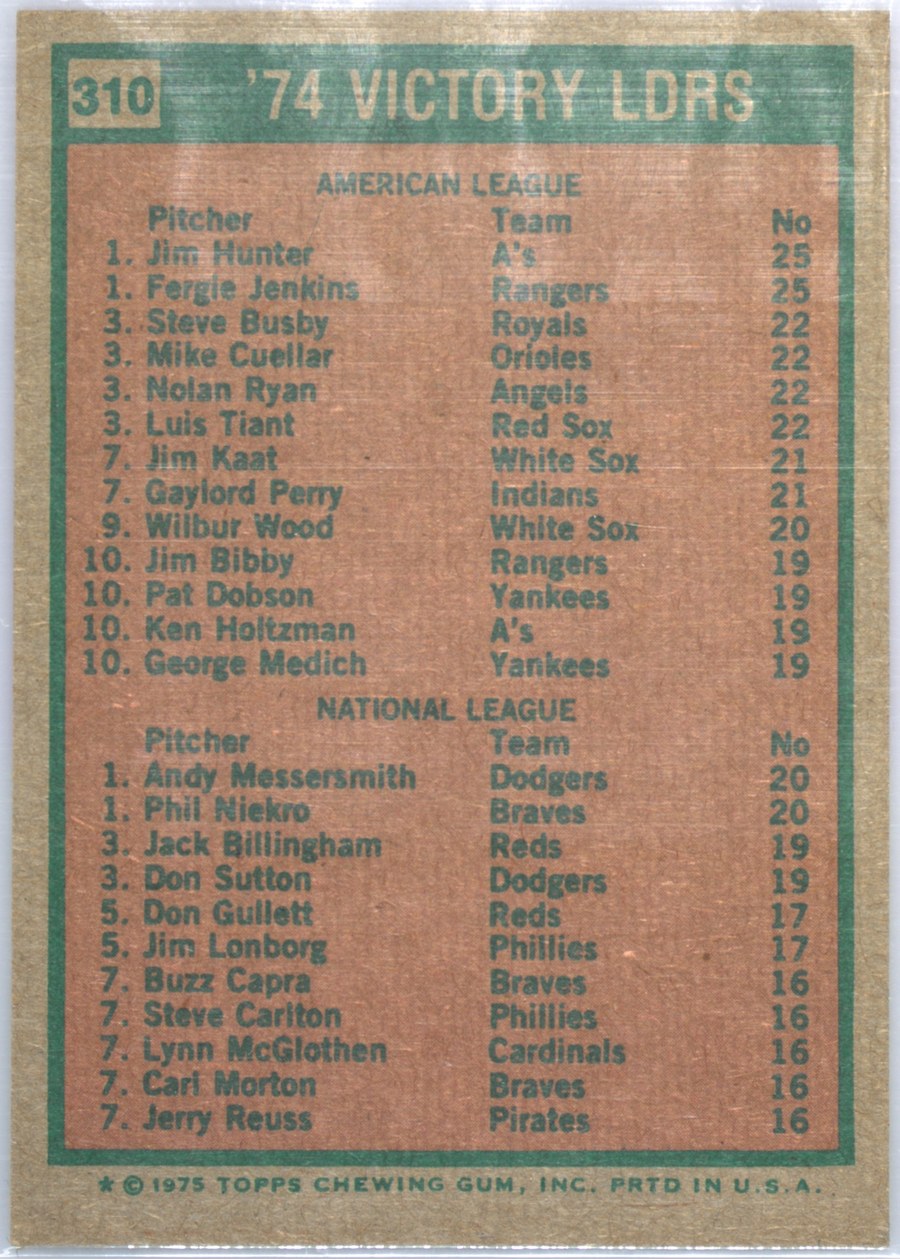
Cards #306-313 are the 1974 League Leaders subset, pairing the American and National League leaders in eight statistical categories.
About the players on this card
Jim Hunter
James Augustus "Catfish" Hunter signed with the Kansas City Athletics in June 1964, missed that season with a hunting injury, and reached the majors in May 1965 without playing in the minors. Owner Charlie Finley invented the nickname for him that year — not, as later legend held, a boyhood fishing tale. An eight-time All-Star (1966-67, 1970, 1972-76), Hunter threw the AL's first perfect game in 46 years on May 8, 1968, beating Minnesota 4-0 and driving in three runs himself. He won 20-plus games four straight seasons, anchored three straight World Series titles (1972-74), and took the 1974 AL Cy Young Award on a league-leading 25 wins and 2.49 ERA — the two stats behind League Leaders cards #310-311. That December an arbitrator voided his A's contract over an unpaid annuity, making him baseball's first big-money free agent — the story behind base card #230, captioned simply "Jim Hunter." He won 23 games in his first Yankee season, helped New York to three straight pennants, and added two more titles (1977-78). Arm trouble ended his career after 1979 at 224-166, 3.26 ERA. Hunter entered the Hall of Fame in 1987 and died of ALS in 1999 at 53.
Sources: Wikipedia · SABR BioProject · Baseball-Reference
Fergie Jenkins
Ferguson "Fergie" Jenkins broke into the majors with the Philadelphia Phillies in 1965 before an April 1966 trade sent him to the Chicago Cubs, where he strung together six consecutive 20-win seasons (1967-72) — a streak unmatched since Warren Spahn. His signature year came in 1971: a 24-13 record, 2.77 ERA, and 263 strikeouts against only 37 walks earned him the National League Cy Young Award, making him the first Cubs pitcher and first Canadian to win it. Dealt to the Texas Rangers for 1974, he responded with a career-best 25 victories, leading the American League and setting a franchise record that still stands — the feat captured on his 1975 Topps League Leaders card (#310, "1974 Victory Leaders"), alongside his Rangers base card (#60). He retired with 284 wins, the most by a Black pitcher in major-league history, and 3,192 strikeouts, one of just four pitchers ever to top 3,000 strikeouts with fewer than 1,000 walks. Raised in Chatham, Ontario, Jenkins entered the National Baseball Hall of Fame in 1991 as the first Canadian so honored.
Sources: Wikipedia · SABR BioProject · Baseball-Reference
Andy Messersmith
A hard-throwing right-hander out of Cal Berkeley, Messersmith broke in with the Angels in 1968 and made his first All-Star team in 1971, going 20-13. Traded to the Dodgers that November, he anchored the rotation that won the 1974 NL pennant, going 20-6 with a 2.59 ERA, leading the league in wins, starting the All-Star Game, and taking home a Gold Glove — the pedigree behind the All-Star flag on his 1975 Topps #440 card. He also appears on #310, the "'74 Victory Leaders" card shared with fellow 20-game winner Phil Niekro and AL leaders Catfish Hunter and Fergie Jenkins. In 1975 he posted a career-best 2.29 ERA and a second Gold Glove, but the season's lasting significance came off the mound: he pitched all year unsigned, and arbitrator Peter Seitz's December 1975 ruling in his case struck down the reserve clause and opened the door to free agency. Messersmith signed with Atlanta in 1976, briefly wearing "Channel" on his jersey — an ad for owner Ted Turner's TV station until the league banned it — before switching to "Bluto," a Dodgers-era nickname for his beard and Popeye-thick arms. He finished 130-99 with a 2.86 ERA over 12 seasons and is not enshrined in the Hall of Fame.
Sources: Wikipedia · SABR BioProject · Baseball-Reference
Phil Niekro
Phil Niekro turned pro on July 19, 1958, signing with the Milwaukee Braves out of Bridgeport, Ohio, after his father - a coal miner and semipro pitcher - taught him the knuckleball in the backyard. That pitch carried him through a 24-year career (1964-1987), mostly with the Milwaukee/Atlanta Braves, later with the Yankees, Indians, and Blue Jays. Nicknamed "Knucksie" for his command of the pitch, he led the NL in wins in both 1974 and 1979, topped the majors in ERA in 1967, and no-hit the Padres on August 5, 1973. His 20-win, league-leading 1974 season is captured on his 1975 Topps League Leaders card (#310) alongside AL wins leader Catfish Hunter; his solo issue that year is #130. A five-time All-Star, Niekro also won five NL Gold Gloves (1978-1980, 1982-1983). At 46, he became the oldest pitcher to throw a major-league shutout while notching win No. 300 on October 6, 1985. He retired with 318 victories, still the most by any knuckleballer, and was inducted into the Baseball Hall of Fame in 1997.
Sources: Wikipedia · SABR BioProject · Baseball-Reference
Graded population (PSA & SGC)
| Grader | Total | 10 | 9 | 8 | 7 | 6 | 5 | 1-4 | Auth |
|---|---|---|---|---|---|---|---|---|---|
| PSA | 439 | 2 | 64 | 243 | 56 | 14 | 43 | 16 | 1 |
| SGC | 33 | 0 | 1 | 10 | 6 | 6 | 3 | 6 | 1 |
Graded population — a scarcity guide, not a price. Snapshot 2026-08-19. Half grades fold down for both graders (8.5→8); PSA qualified slabs (OC, ST, PD, MC and the like) are not counted. The graders do not split the 1975 Topps Mini or O-Pee-Chee issues into this set.
Find this card
Search T206 Cards Live auctions Buy It Now Sold prices
As an eBay Partner Network affiliate, T206Cards.com may earn from qualifying purchases.
Related cards
Team card: #561 Oakland Athletics
More Oakland Athletics cards:
- #21 Rollie Fingers
- #45 Joe Rudi
- #69 John Odom
- #91 Dick Green
- #121 Bill North
- #145 Ken Holtzman
- #170 Bert Campaneris
- #209 1971 MVPs
- #211 1973 MVPs
- #230 Jim Hunter
- #253 Jesus Alou
- #278 Paul Lindblad
- #300 Reggie Jackson
- #309 1974 Stolen Base Leaders
Frequently asked questions
What is the 1975 Topps #310 card?
It is card #310 of the 660-card 1975 Topps Baseball set, picturing Jim Hunter, Fergie Jenkins, Andy Messersmith, Phil Niekro. Cards #306-313 are the 1974 League Leaders subset, pairing the American and National League leaders in eight statistical categories.
How many cards are in the 1975 Topps Baseball set?
660 cards, numbered 1-660, with no variations and no short prints - PSA reports the cards were printed in equal quantities. The 1975 Topps Mini and the 1975 O-Pee-Chee issues are separate products with their own checklists.
Sources: Trading Card Database, Cardboard Connection, the PSA price guide, Baseball-Reference, the SABR BioProject and the National Baseball Hall of Fame, PSA & SGC population reports. Card data compiled and maintained by T206Cards.com. Page last updated 2026-10-05.