
1954 Topps #39 Sherm Lollar

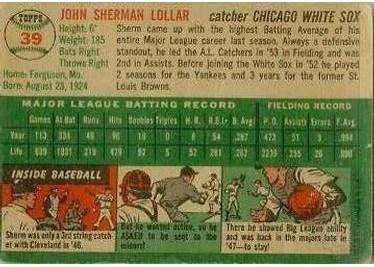
About Sherm Lollar
John Sherman "Sherm" Lollar was a right-handed catcher signed at age 18 in 1943 by the Baltimore Orioles of the International League, where he won the 1945 IL MVP award batting .364 with 34 home runs and 111 RBI. He reached the majors with Cleveland in 1946 and went on to play 18 seasons (1946-1963) for the Indians, New York Yankees (1947-1948), St. Louis Browns (1949-1951), and Chicago White Sox (1952-1963), his longtime home. A seven-time All-Star (1950, 1954-1956, 1958-1960), Lollar was one of the American League's premier defensive catchers, winning the first three AL Gold Glove Awards ever given at the position (1957, 1958, 1959). He anchored the pitching staff of the 1959 "Go-Go" White Sox that won the pennant; in that World Series loss to the Dodgers he hit a three-run homer off Roger Craig in Game 4. Over 1,752 games he batted .264 with 155 home runs and 808 RBI. He later coached, earning a ring with the 1966 Baltimore Orioles. Lollar died of cancer in 1977; he has not been elected to the Hall of Fame.
Sources: Wikipedia · Baseball-Reference · SABR
Variations & how to tell them apart
White Back / Gray Back Series 1 (cards 1-50)
Every card in the first series exists with the standard white/cream back (United States) and a scarcer gray back printed for the Canadian market. The grays were printed in Canada on a darker, gray cardstock and distributed in Canadian nickel packs; they exist for cards 1-50 only and carry a small-to-moderate premium. This is the genuine 'Canadian' issue from which the 1952 Topps gray-back 'Canadian' myth mistakenly borrowed its name.
- White Back: Standard United States issue. White/cream card stock - the common back for cards 1-50.
- Gray Back — scarcer: The Canadian printing. Printed in Canada on a visibly gray/darker cardstock and distributed in Canadian packs; exists for the first series (#1-50) only. Scarcer than the white back and carries a premium - modest on commons, meaningful on the stars (Williams, Robinson, Spahn, Snider, Ford, Berra, etc.). Tell: the back stock is uniformly gray - not to be confused with edge-toning on a white back.
Graded population (PSA & SGC)
| Grader | Total | 10 | 9 | 8 | 7 | 6 | 5 | 1-4 | Auth |
|---|---|---|---|---|---|---|---|---|---|
| PSA | 490 | 0 | 4 | 68 | 127 | 139 | 83 | 69 | 0 |
| SGC | 67 | 0 | 0 | 5 | 11 | 7 | 16 | 28 | 0 |
PSA by back: White Back 484 · Gray Back 6
SGC by back: White Back 65 · Gray Back 2
Graded population — a scarcity guide, not a price. Snapshot 2026-06-26. Half grades fold down for both graders (8.5→8); PSA qualified slabs (OC, ST, PD, MC and the like) are not counted. Totals are summed across each grader's listed variations.
Find this card
Search T206 Cards Live auctions Buy It Now Sold prices
As an eBay Partner Network affiliate, T206Cards.com may earn from qualifying purchases.
More Chicago White Sox cards
- Johnny Lipon
- Ferris Fain
- Jim Rivera
- Luis Aloma
- Bob Wilson
- Bob Keegan
- Harry Dorish
- Bob Boyd
- Don Johnson
- Mike Fornieles
- Jack Harshman
- Carl Sawatski
- Al Sima
- Fred Marsh
Frequently asked questions
What is the 1954 Topps Sherm Lollar card?
It is card #39 of 250 in the 1954 Topps set, issued at the peak of the Topps-Bowman 'Card Wars'. It pictures the Chicago White Sox player.
Does the 1954 Topps Sherm Lollar have back variations?
Yes. Every card in the first series exists with the standard white/cream back (United States) and a scarcer gray back printed for the Canadian market. The grays were printed in Canada on a darker, gray cardstock and distributed in Canadian nickel packs; they exist for cards 1-50 only and carry a small-to-moderate premium. This is the genuine 'Canadian' issue from which the 1952 Topps gray-back 'Canadian' myth mistakenly borrowed its name.
Is the 1954 Topps Sherm Lollar valuable?
Value depends on grade and (where it applies) the back variation. Use the links above to check current T206 Cards inventory and live eBay listings.
Sources: Trading Card Database, Baseball-Reference, PSA & SGC population reports, and Baseball-Almanac. Card data & population compiled and maintained by T206Cards.com. Page last updated 2026-10-05.