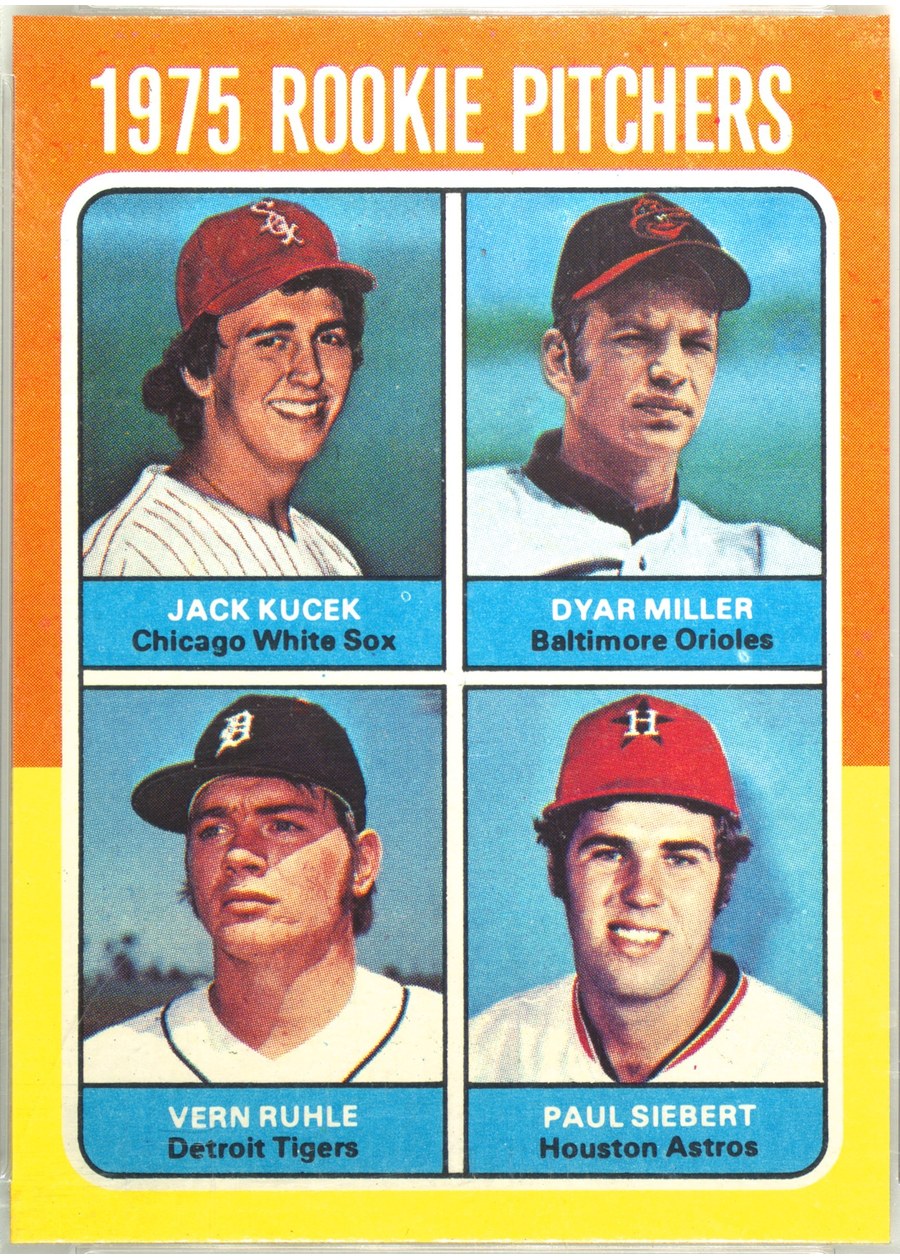
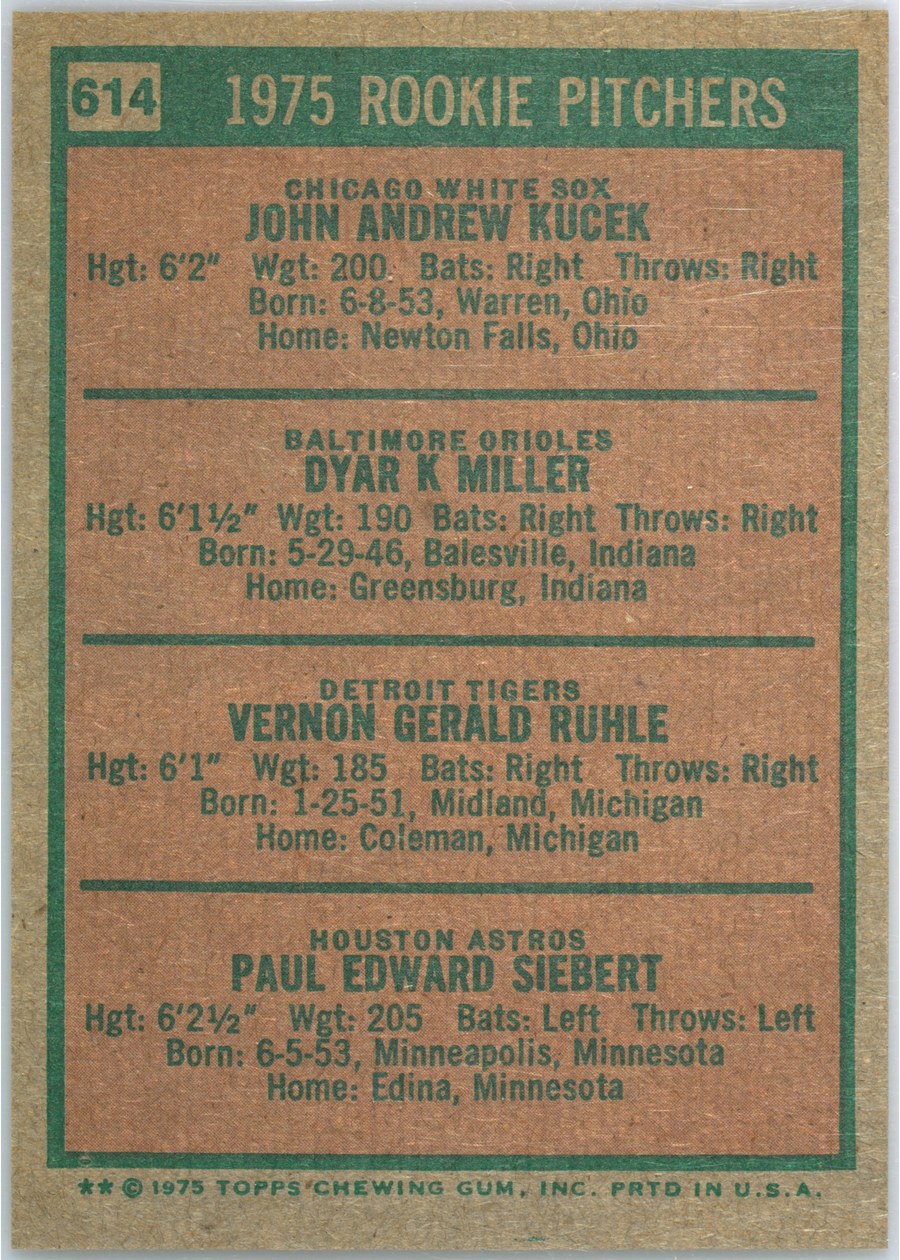
1975 Topps #614 1975 Rookie Pitchers
One of the eleven four-player rookie cards (#614-624).
About this card
Cards #614-624 are the multi-player Rookie cards, four prospects to a card grouped by position - the run that carries the Rice, Carter, Lynn and Hernandez rookies.
About the players on this card
Jack Kucek
John Andrew Charles Kucek, a right-hander out of Warren, Ohio's Newton Falls High School and Miami University, was picked by the Chicago White Sox in the second round of the 1974 draft after they had already selected him in the sixth round back in 1971. He moved fast, jumping from Class A Appleton to the majors within months and debuting August 8, 1974, against the California Angels. Kucek's 1975 Topps card (#614) is a four-player Rookie Pitchers issue shared with three other White Sox farmhands, and it stands as his recognized rookie card. He split the next several seasons between Chicago's rotation and bullpen and its Triple-A affiliates, was dealt to the Philadelphia Phillies for Jim Morrison in 1979, then signed with the Toronto Blue Jays in January 1980. Across parts of seven big-league seasons (1974-1980) with the White Sox, Phillies, and Blue Jays, he went 7-16 with a 5.12 ERA, 121 strikeouts, and two saves in 59 appearances before retiring after the 1981 season in Toronto's system.
Sources: Wikipedia · Baseball-Reference
Dyar Miller
Dyar K. Miller broke into pro ball in 1968, signing with the Phillies as a catcher for $1,500 before Baltimore converted him to the mound the following year. A Utah State product, he spent parts of seven big-league seasons (1975-1981) with the Orioles, Angels, Blue Jays, and Mets, debuting at age 29 against Oakland on June 9, 1975, after manager Earl Weaver initially held him back in Triple-A that spring. Working almost exclusively in relief, the right-hander went 23-17 with 22 saves and a 3.23 ERA over 251 games. His rookie card, 1975 Topps #614 "Rookie Pitchers," pairs him with Jack Kucek, Vern Ruhle, and Paul Siebert. After retiring as a player in 1984, Miller spent 28 seasons coaching, 19 of them in the Cardinals' system, capping his career as St. Louis's bullpen coach in 2012. He was inducted into the Indiana Baseball Hall of Fame in 2007.
Sources: Wikipedia · SABR BioProject · Baseball-Reference
Vern Ruhle
Vern Ruhle was drafted by Detroit in the 17th round of the 1972 draft out of Olivet College, debuted in September 1974, and won a rotation spot in 1975, going 11-12 for a 57-102 Tigers club — the same season captured on his rookie card, Topps #614, a four-player "Rookie Pitchers" issue shared with Dyar Miller, Jack Kucek, and Paul Siebert. That rookie year held two indelible moments: on May 1 he served up Hank Aaron's record-breaking 2,210th career RBI, and on September 21 a Ruhle pitch broke Jim Rice's hand, knocking the young Red Sox slugger out of Boston's run to the 1975 World Series. Released by Detroit in 1978, Ruhle found his best form in Houston, going 12-4 with a 2.38 ERA in 1980 as the Astros won their first division title, then started postseason games in the 1980 NLCS and 1981 NLDS. He finished 67-88 with a 3.73 ERA over 13 seasons, closing out with Cleveland and California before a decade as pitching coach for the Astros, Phillies, Mets, and Reds. He died of multiple myeloma in January 2007.
Sources: Wikipedia · SABR BioProject · Baseball-Reference
Paul Siebert
Paul Edward Siebert was born June 5, 1953, in Minneapolis, the son of former major-league first baseman and longtime University of Minnesota head coach Dick Siebert. A left-handed pitcher out of Edina High School, he was chosen by the Houston Astros in the third round of the 1971 draft, taken seven picks ahead of future Yankees ace Ron Guidry. Siebert went 36-24 with a 2.86 ERA over three Astros farm seasons before a September 1974 call-up, and in just his second big-league start he shut out the Giants on four hits. He shares his 1975 Topps rookie card, #614 "Rookie Pitchers," with fellow first-year arms Dyar Miller, Vern Ruhle, and Jack Kucek. Traded to San Diego in 1977, Siebert was flipped to the Mets that June in the blockbuster that also sent Tom Seaver to Cincinnati — the "Midnight Massacre." He won and scored the winning run in New York's 17-inning marathon against Montreal that July, one of only two victories in a career that closed after 1978 at 3-8 with a 3.77 ERA.
Sources: Wikipedia · Baseball-Reference
Graded population (PSA & SGC)
| Grader | Total | 10 | 9 | 8 | 7 | 6 | 5 | 1-4 | Auth |
|---|---|---|---|---|---|---|---|---|---|
| PSA | 538 | 23 | 176 | 269 | 45 | 8 | 7 | 10 | 0 |
| SGC | 23 | 0 | 10 | 11 | 0 | 1 | 0 | 1 | 0 |
Graded population — a scarcity guide, not a price. Snapshot 2026-08-19. Half grades fold down for both graders (8.5→8); PSA qualified slabs (OC, ST, PD, MC and the like) are not counted. The graders do not split the 1975 Topps Mini or O-Pee-Chee issues into this set.
Find this card
Search T206 Cards Live auctions Buy It Now Sold prices
As an eBay Partner Network affiliate, T206Cards.com may earn from qualifying purchases.
Related cards
Team card: #276 Chicago White Sox
More Chicago White Sox cards:
- #11 Bill Melton
- #35 Ron Santo
- #59 Ken Henderson
- #82 Pat Kelly
- #110 Wilbur Wood
- #137 Terry Forster
- #161 Stan Bahnsen
- #184 Jorge Orta
- #197 1959 MVPs
- #210 1972 MVPs
- #219 Ed Herrmann
- #243 Jim Kaat
- #299 Bucky Dent
- #307 1974 Home Run Leaders
Frequently asked questions
What is the 1975 Topps #614 card?
It is card #614 of the 660-card 1975 Topps Baseball set, picturing Jack Kucek, Dyar Miller, Vern Ruhle, Paul Siebert. Cards #614-624 are the multi-player Rookie cards, four prospects to a card grouped by position - the run that carries the Rice, Carter, Lynn and Hernandez rookies.
Is 1975 Topps #614 a rookie card?
Yes - #614 is a rookie card. Topps grouped four prospects on each card in the 1975 Rookies run, so the rookie designation covers every player pictured: Jack Kucek, Dyar Miller, Vern Ruhle, Paul Siebert.
How many cards are in the 1975 Topps Baseball set?
660 cards, numbered 1-660, with no variations and no short prints - PSA reports the cards were printed in equal quantities. The 1975 Topps Mini and the 1975 O-Pee-Chee issues are separate products with their own checklists.
Sources: Trading Card Database, Cardboard Connection, the PSA price guide, Baseball-Reference, the SABR BioProject and the National Baseball Hall of Fame, PSA & SGC population reports. Card data compiled and maintained by T206Cards.com. Page last updated 2026-10-05.