
1975 Topps #616 1975 Rookie Outfielders
Jim Rice's rookie card, shared with three players who combined for fewer than 500 big-league games.
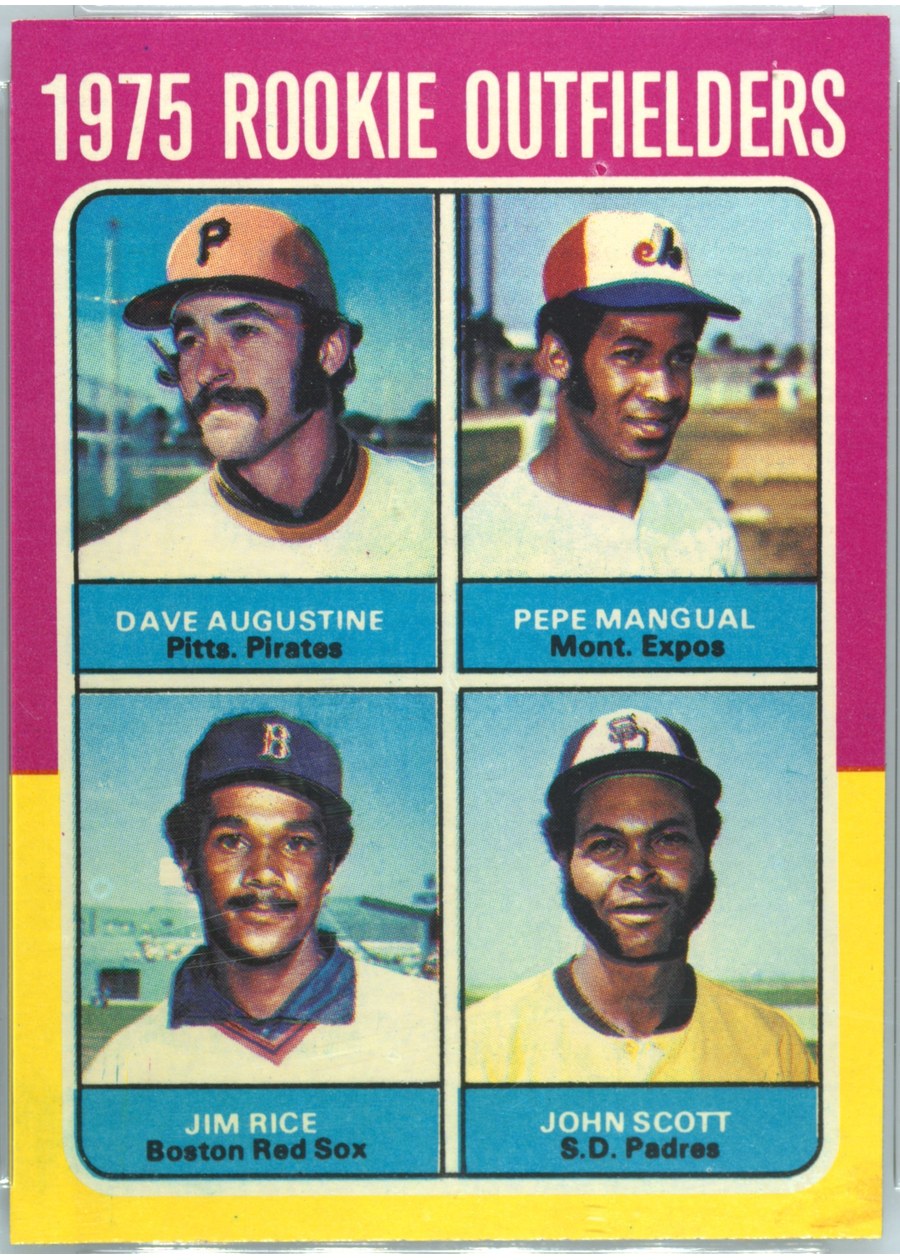
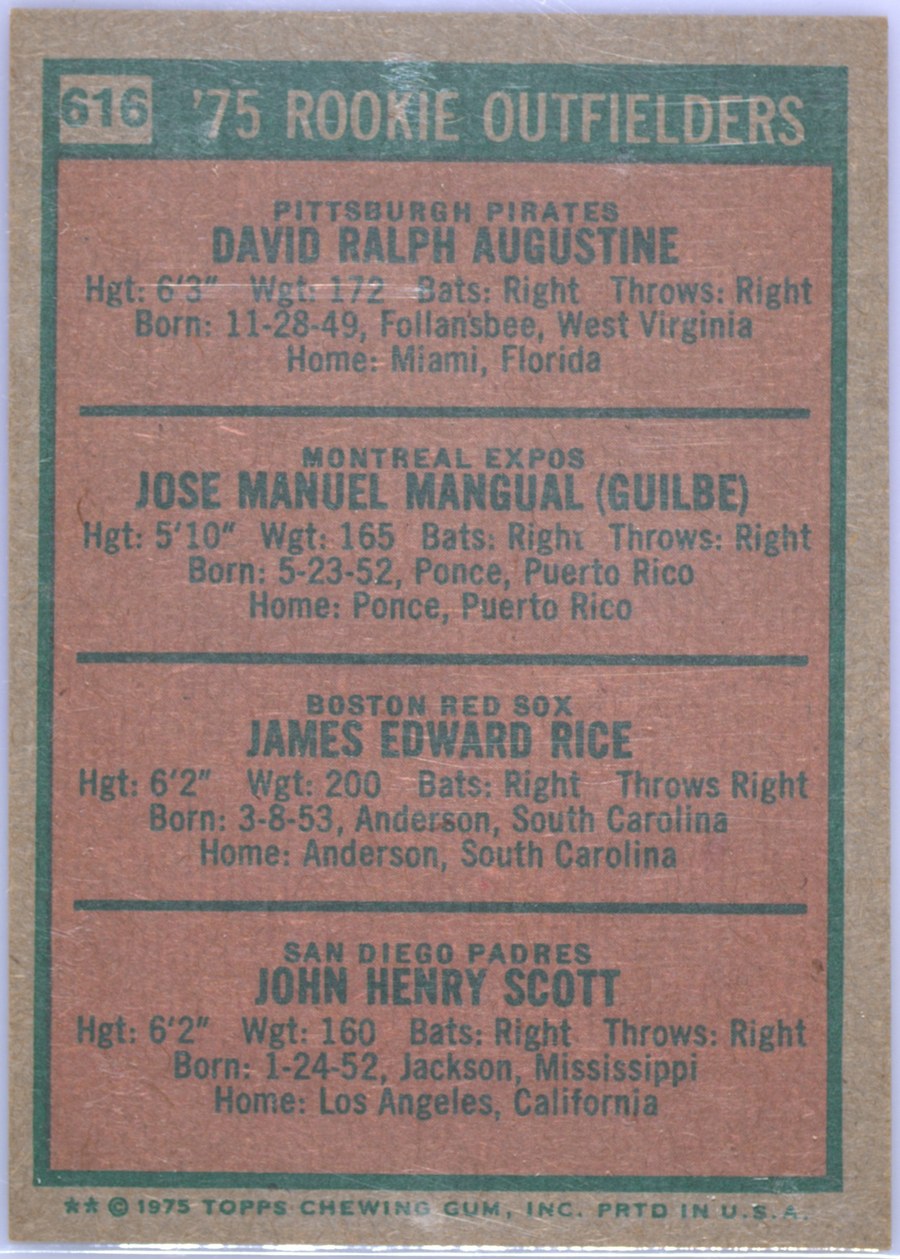
About this card
Cards #614-624 are the multi-player Rookie cards, four prospects to a card grouped by position - the run that carries the Rice, Carter, Lynn and Hernandez rookies.
About the players on this card
Dave Augustine
Dave Augustine broke into pro ball out of Southwest Miami High and Miami Dade College, taken by the Cleveland Indians in the 33rd round of the 1968 draft. He reached the majors with the Pittsburgh Pirates, debuting September 3, 1973, and played 29 games as an outfielder and pinch runner over two seasons (1973-1974), batting .207 with six hits. His signature moment came September 20, 1973, in a pennant-race game at Shea Stadium. Pinch-running earlier, he had scored Pittsburgh's go-ahead run in the ninth. In the 13th, his deep drive to left caromed off the very top of the wall into Cleon Jones' glove; the relay through Wayne Garrett nailed Richie Zisk at the plate. Immortalized as the "Ball on the Wall," the play kept the Mets alive for their "Ya Gotta Believe" pennant run. Augustine spent parts of seven seasons starring for the Charleston Charlies, winning a 1979 Silver Glove Award for errorless outfield play, and shares his 1975 Topps rookie card, #616, with Hall of Famer Jim Rice.
Sources: Wikipedia · Baseball-Reference
Pepe Mangual
José Manuel "Pepe" Mangual Guilbe was born May 23, 1952, in Ponce, Puerto Rico, and signed with the Montreal Expos as an amateur free agent in 1969. He hit .330 in his first pro season and reached the majors on September 6, 1972. Mangual became Montreal's starting center fielder in 1975, playing all 140 games and hitting .245 with 74 walks, 84 runs, and 33 stolen bases — sixth-most in the National League. That breakout year underlies his 1975 Topps rookie card, #616, a four-player "Rookie Outfielders" issue shared with Dave Augustine, John Scott, and future Hall of Famer Jim Rice, making it one of the set's key cards. Traded to the Mets with Jim Dwyer for Wayne Garrett and Del Unser on July 21, 1976, he struggled in New York and played his last game on October 2, 1977. He spent seven more minor-league seasons, mostly in the Angels' system, retiring in 1984 with a .242 career average, 16 home runs, and 83 RBI. His brother Ángel Mangual also reached the majors.
Sources: Wikipedia · Baseball-Reference
Jim Rice
James Edward "Jim Ed" Rice — the name friends and family in Anderson, South Carolina used for him — was Boston's 1971 first-round pick (15th overall), turning down football scholarships to sign. He tore through the minors, winning the 1974 International League Triple Crown, MVP and Rookie of the Year at Triple-A Pawtucket before debuting with the Red Sox that August. His 1975 Topps card, #616, is a shared "Rookie Outfielders" issue with Dave Augustine, Pepe Mangual and John Scott, but it ranks among the set's key rookie cards, catching Rice on the eve of stardom alongside fellow rookie Fred Lynn — together the "Gold Dust Twins." A wrist injury sidelined him for Boston's 1975 World Series loss to Cincinnati, but he became the era's premier power hitter: an eight-time All-Star, three-time AL home run leader, and 1978 AL MVP after batting .315 with 46 homers, 139 RBIs and 406 total bases, the first player in 19 years to clear 400. He spent all 16 seasons in left field and at DH for Boston, retiring with 382 homers, 2,452 hits and a .298 average, and entered the Hall of Fame in 2009.
Sources: Wikipedia · SABR BioProject · Baseball-Reference
John Scott
John Henry Scott was the Padres' first-round pick, second overall in the January phase of the 1970 draft, out of Centennial High School in Compton, California. The outfielder debuted with San Diego on September 7, 1974, but spent two seasons mostly as a pinch-runner, collecting just one hit in 24 at-bats. After batting .315 with 15 home runs and 38 stolen bases for Triple-A Hawaii in 1976, he was purchased by the expansion Toronto Blue Jays and, on April 7, 1977, became the first batter in franchise history, striking out against Chicago's Ken Brett. Scott took over as the Blue Jays' regular center fielder that May and hit both his career home runs during a June hot streak, finishing 1977 at .240 in 79 games, his final major-league season. He later found his power stroke in Japan, batting .262 with 48 homers for the Yakult Swallows from 1979-1981. His 1975 Topps rookie card, #616, is shared with Dave Augustine, Pepe Mangual, and future Hall of Famer Jim Rice.
Sources: Wikipedia · Baseball-Reference
Graded population (PSA & SGC)
| Grader | Total | 10 | 9 | 8 | 7 | 6 | 5 | 1-4 | Auth |
|---|---|---|---|---|---|---|---|---|---|
| PSA | 4,771 | 8 | 233 | 1,353 | 1,250 | 836 | 512 | 575 | 4 |
| SGC | 994 | 0 | 19 | 133 | 239 | 248 | 148 | 183 | 24 |
Graded population — a scarcity guide, not a price. Snapshot 2026-08-19. Half grades fold down for both graders (8.5→8); PSA qualified slabs (OC, ST, PD, MC and the like) are not counted. The graders do not split the 1975 Topps Mini or O-Pee-Chee issues into this set.
Find this card
Search T206 Cards Live auctions Buy It Now Sold prices
As an eBay Partner Network affiliate, T206Cards.com may earn from qualifying purchases.
Related cards
Team card: #304 Pittsburgh Pirates
More Pittsburgh Pirates cards:
- #29 Dave Parker
- #53 Dave Giusti
- #77 Richie Zisk
- #100 Willie Stargell
- #124 Jerry Reuss
- #148 Jim Rooker
- #171 Ed Kirkpatrick
- #224 Ramon Hernandez
- #250 Ken Brett
- #277 Frank Taveras
- #336 Rennie Stennett
- #359 Paul Popovich
- #385 Dock Ellis
- #409 Bob Robertson
Frequently asked questions
What is the 1975 Topps #616 card?
It is card #616 of the 660-card 1975 Topps Baseball set, picturing Dave Augustine, Pepe Mangual, Jim Rice, John Scott. Cards #614-624 are the multi-player Rookie cards, four prospects to a card grouped by position - the run that carries the Rice, Carter, Lynn and Hernandez rookies.
Is 1975 Topps #616 a rookie card?
Yes - #616 is a rookie card. Topps grouped four prospects on each card in the 1975 Rookies run, so the rookie designation covers every player pictured: Dave Augustine, Pepe Mangual, Jim Rice, John Scott.
How many cards are in the 1975 Topps Baseball set?
660 cards, numbered 1-660, with no variations and no short prints - PSA reports the cards were printed in equal quantities. The 1975 Topps Mini and the 1975 O-Pee-Chee issues are separate products with their own checklists.
Sources: Trading Card Database, Cardboard Connection, the PSA price guide, Baseball-Reference, the SABR BioProject and the National Baseball Hall of Fame, PSA & SGC population reports. Card data compiled and maintained by T206Cards.com. Page last updated 2026-10-05.