
1975 Topps #208 1970 MVPs
Part of the MVP subset (#189-212) — both league MVPs of one season, rendered in that year's Topps design.
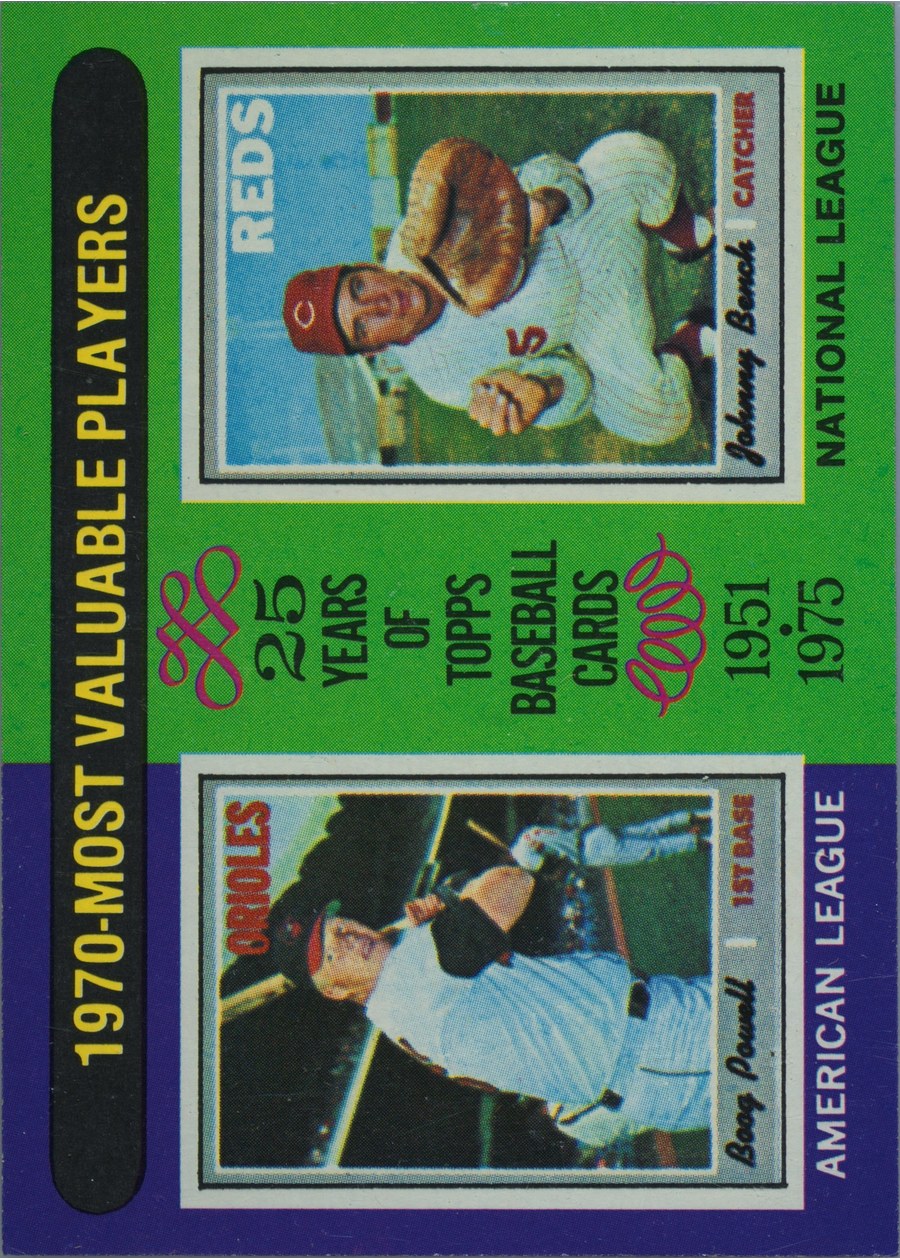
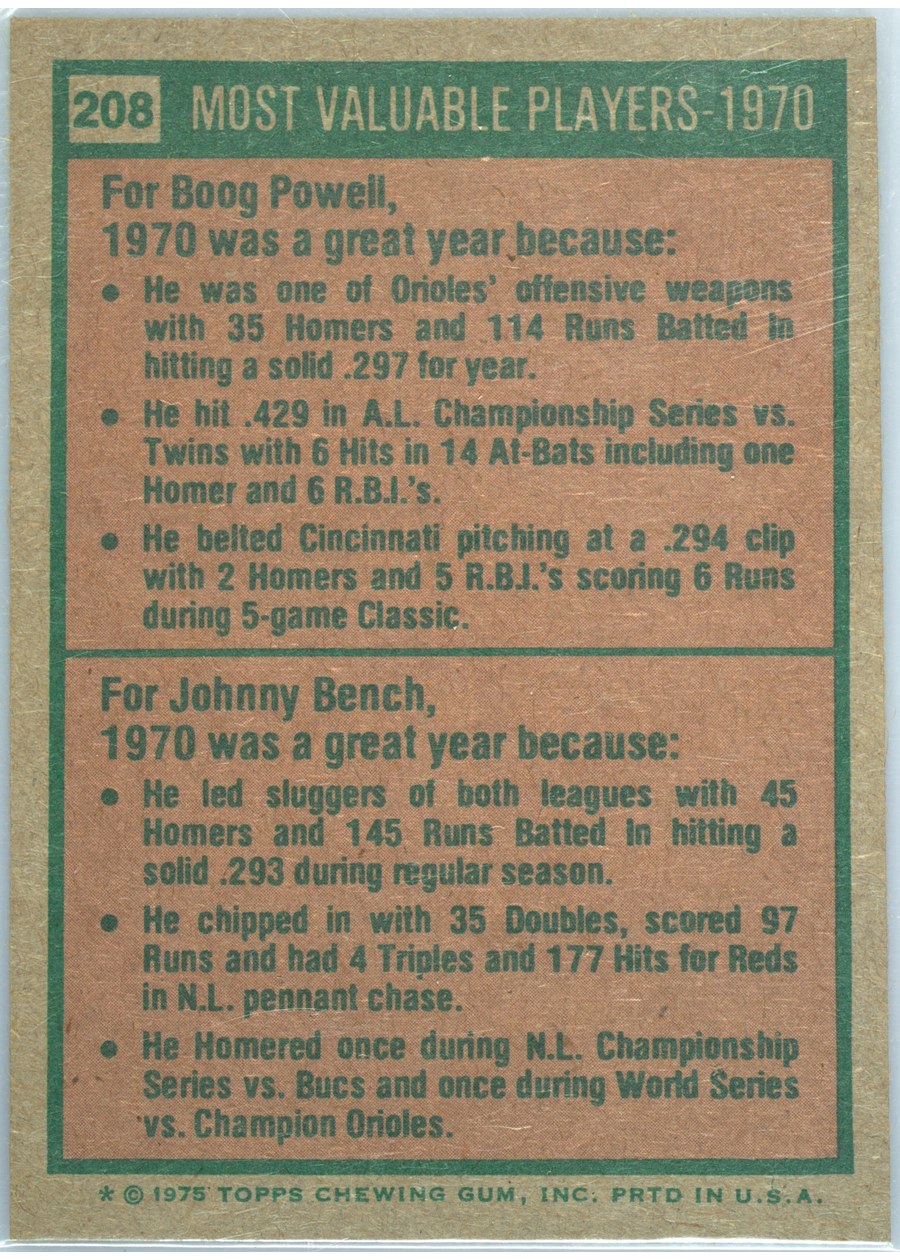
About this card
Cards #189-212 are the MVP subset: twenty-four cards, each pairing the American and National League Most Valuable Players of one season from 1951 through 1974, reproducing their cards from that year.
About the players on this card
Boog Powell
John Wesley "Boog" Powell signed with Baltimore as an amateur free agent in 1959 out of Key West High School, and the burly first baseman anchored the Orioles' dynasty for the better part of fifteen seasons. He broke in with Baltimore in 1961, moved from left field to first base in 1965, and became the middle-of-the-order power source behind Frank and Brooks Robinson through four pennants and two World Series titles (1966, 1970). Powell led the American League with a .606 slugging percentage in 1964, made four straight All-Star teams (1968-71), and capped a career year in 1970 with 35 homers, 114 RBIs and the AL MVP award, homering in each of the first two games of that fall's World Series win over Cincinnati. He got his nickname "Boog" from his father, who shortened the Southern term "boogers" for mischievous kids. Powell finished with 339 home runs, third on the Orioles' all-time list, and was inducted into the Orioles Hall of Fame in 1979. His 1970 MVP season earns him a spot on card #208 alongside that year's NL MVP, in addition to his regular-issue #625.
Sources: Wikipedia · SABR BioProject · Baseball-Reference
Johnny Bench
Johnny Lee Bench redefined the catcher position from Cincinnati, debuting in 1967 and anchoring the Big Red Machine through 1983. A second-round pick out of Binger, Oklahoma in 1965, he won National League Rookie of the Year in 1968, then set the position's gold standard: ten Gold Gloves, a rifle arm, and two MVP awards (1970, 1972) built on power years of 45 and 40 home runs. Nicknamed the "Little General" for the way he commanded pitching staffs and directed fielders from behind the plate, Bench caught 100-plus games in 13 straight seasons and finished with 389 home runs and 1,376 RBI, still the most in Reds history. He drove Cincinnati to four pennants and back-to-back titles in 1975-76, taking World Series MVP in the second. His 1975 Topps card carries the printed 1974 All-Star flag, and he doubles up in that year's MVP subset, once for his 1970 award and again for 1972, plus a spot on the 1974 RBI Leaders card. Bench entered Cooperstown in 1989, his first year of eligibility, with 96.4% of the vote.
Sources: Wikipedia · SABR BioProject · Baseball-Reference
Graded population (PSA & SGC)
| Grader | Total | 10 | 9 | 8 | 7 | 6 | 5 | 1-4 | Auth |
|---|---|---|---|---|---|---|---|---|---|
| PSA | 718 | 6 | 59 | 389 | 175 | 44 | 32 | 13 | 0 |
| SGC | 44 | 0 | 2 | 18 | 11 | 9 | 2 | 2 | 0 |
Graded population — a scarcity guide, not a price. Snapshot 2026-08-19. Half grades fold down for both graders (8.5→8); PSA qualified slabs (OC, ST, PD, MC and the like) are not counted. The graders do not split the 1975 Topps Mini or O-Pee-Chee issues into this set.
Find this card
Search T206 Cards Live auctions Buy It Now Sold prices
As an eBay Partner Network affiliate, T206Cards.com may earn from qualifying purchases.
Related cards
Team card: #117 Baltimore Orioles
More Baltimore Orioles cards:
- #26 Dave McNally
- #50 Brooks Robinson
- #74 Mark Belanger
- #97 Earl Williams
- #142 Bob Reynolds
- #167 Rich Coggins
- #202 1964 MVPs
- #204 1966 MVPs
- #225 Bob Grich
- #247 Enos Cabell
- #275 Paul Blair
- #303 Grant Jackson
- #335 Jim Palmer
- #358 Al Bumbry
Frequently asked questions
What is the 1975 Topps #208 card?
It is card #208 of the 660-card 1975 Topps Baseball set, picturing Boog Powell, Johnny Bench. Cards #189-212 are the MVP subset: twenty-four cards, each pairing the American and National League Most Valuable Players of one season from 1951 through 1974, reproducing their cards from that year.
How many cards are in the 1975 Topps Baseball set?
660 cards, numbered 1-660, with no variations and no short prints - PSA reports the cards were printed in equal quantities. The 1975 Topps Mini and the 1975 O-Pee-Chee issues are separate products with their own checklists.
Sources: Trading Card Database, Cardboard Connection, the PSA price guide, Baseball-Reference, the SABR BioProject and the National Baseball Hall of Fame, PSA & SGC population reports. Card data compiled and maintained by T206Cards.com. Page last updated 2026-10-05.